
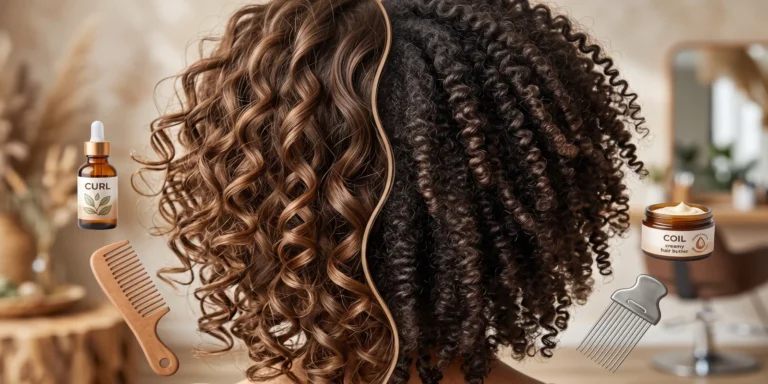
The short answer: curly hair forms loops and spirals you can see with the naked eye, while coily hair forms much tighter coils, often small enough to read as a zigzag rather than a curl.
Both sit under the umbrella of textured hair, and both need moisture and gentle handling. The differences show up in curl tightness, shrinkage, moisture retention, detangling, and which styles hold.
Knowing where you fall in the coily hair vs curly hair comparison shapes the products you buy, the routine you build, and the hair extensions you choose. This guide covers what each texture is, how they differ, how to care for and style them, and how to work out which one you have.
What Is Curly Hair?
Curly hair grows in a visible curved pattern rather than falling straight. The shape comes from the follicle: a more oval or curved one produces a strand that bends as it grows, and the bend repeats down the length. Patterns run from loose, open waves through springy ringlets to tight corkscrews, and most people in this group notice the same handful of things:
- Curl definition shifts with handling. Brushing dry curls usually breaks the pattern into frizz.
- Moisture is a constant need, since scalp oils travel slowly down a curved strand and the ends dry out first.
- Frizz appears when the hair is dry or when humidity meets a strand that wants moisture.
- Shrinkage happens here too, though usually less dramatically than with coils.
Understanding Curly Hair Texture
Curly hair texture is not one thing. A loose S-wave and a tight ringlet behave differently in almost every way, so two people can both say “curly” and share no routine at all.
Strand thickness matters as well. Fine curly hair is easily weighed down by rich creams, while coarse hair can absorb the same product and still feel dry. Density changes how long washing takes and how much product you get through.
What Is Coily Hair?
Coily hair grows in very tight curls, often forming small springs or a sharp zigzag. The coils can be as narrow as a pen spring or tighter, with the pattern visible in the strand itself rather than in large loops. Common characteristics:
- Tight curl pattern, sometimes with sharp angles instead of smooth curves
- High shrinkage, so the hair looks far shorter dry than it measures stretched
- Dense appearance, since tightly packed coils fill space and read as volume
- Moisture retention challenges, because oils have a long, winding path down each strand
- Vulnerability at the bends, where rough handling can cause breakage
That last point needs reading carefully. Coily hair is not weak or unhealthy by nature; it responds poorly to rough treatment, which is a different statement.
Understanding Coily Hair Texture
Coily hair texture varies as much as any other. Some coils are springy and bounce back when stretched; others follow a tighter zigzag with less spring, and some feel thick as a mass while being fine strand by strand. Multiple patterns on one head are normal, which means a single product or technique may not work everywhere.
Difference Between Curly and Coily Hair
| Feature | Curly Hair | Coily Hair |
| Curl pattern | Visible loops, ringlets, spirals | Tight coils, springs, zigzags |
| Curl tightness | Loose to tight, generally open shapes | Very tight, small circumference |
| Shrinkage | Noticeable, usually moderate | Often significant |
| Density | Varies widely by individual | Frequently reads as dense and full |
| Moisture needs | High, especially at the ends | High throughout, often layered |
| Frizz | Common when dry or in humidity | Common, though texture can mask it |
| Detangling | Best on damp, conditioned hair | Best damp, conditioned and sectioned |
| Styling | Holds definition with light product | Often needs stretching or set styles |
| Product needs | Lighter creams and gels often work | Richer creams, butters, oils often suit |
Here is what those rows mean day to day.
Curl Pattern
Curly hair makes loops with space inside them; you can see through a curl. Coily hair turns so tightly the coil closes on itself, and some strands bend at angles rather than curving. Tighter turns mean more surface area per inch, so coily hair usually needs more product to feel coated.
Shrinkage
This is where the coily hair vs curly hair difference is most obvious. A curly strand measuring ten inches stretched might sit at six or seven when dry; a coily strand of the same length can look like three or four. Nothing is wrong when this happens, but it does mean measuring stretched length, particularly when ordering extensions.
Moisture and Hydration
Both textures need moisture; what differs is delivery. Curly hair often does well with a leave-in and a light cream. Coily hair frequently needs layers, a water-based leave-in sealed with a cream or oil, refreshed more often. Porosity matters too, since hair that absorbs and loses water fast needs different handling from hair that resists it, and that varies within both groups.
Density and Fragility
Density is about how many strands you have, not how tightly they curl, so fine coily hair and thick curly hair both exist. Neither texture is fragile by default; both break under tension, heat, and constant manipulation, and both hold up when handled gently.
Curly Hair Care
Curly hair care works best when it is consistent rather than complicated.
Washing Curly Hair
Use a gentle cleanser focused on the scalp, where buildup collects. Stripping shampoos leave curls dry and frizzy. Follow with conditioner through the lengths, and deep condition when the hair asks for it rather than on someone else’s schedule.
Detangling Curly Hair
Detangle damp hair with conditioner in it, never dry. Start at the ends and work upward in sections with fingers or a wide-tooth comb. Rushing this step is the fastest way to lose length.
Moisturising Curly Hair
Apply leave-in products to damp hair so you seal water in rather than coating dry strands. Watch for buildup, since heavy products layered over each other flatten the pattern, and clarify occasionally to reset.
Protecting Curl Definition
Skip brushing dry curls unless you want volume instead of definition. Scrunching and finger coiling support the pattern, and a satin or silk pillowcase or bonnet protects it overnight.
Coily Hair Care
Coily hair care follows the same principles with more emphasis on moisture and less on manipulation. No single routine suits everyone, so treat this as a starting point.
Keeping Coily Hair Moisturised
Layering usually beats one heavy product: water or a water-based leave-in, then a cream, then an oil or butter to slow moisture loss. Refresh with water and a light product between washes rather than piling cream onto dry hair.
Detangling Without Excessive Manipulation
Section into four to six parts and work one at a time on damp, conditioned hair, fingers first and a wide-tooth comb after if needed. Detangling dry coily hair is where much avoidable breakage happens.
Protecting Coils From Breakage
Keep tension low. Tight styles, tight elastics, and constant restyling stress the same points repeatedly. Trim split ends when they appear, since they travel up the strand, and go easy on heat.
Maintaining Scalp and Hair Health
The scalp needs cleansing even when the lengths feel dry, since skipping washes for too long leads to buildup and itching. If you wear protective styles, keep them clean and rest the hair between installations.
Curly Hair Styling
Curly hair styling is mostly about working with the pattern instead of against it.
Wash-and-go – Apply product to soaking wet hair, encourage the pattern, then leave it alone while it dries. Touching it mid-dry creates frizz.
Twist-outs and braid-outs – Setting damp hair in twists or braids and unravelling once dry gives a stretched, more uniform result.
Defined curls – A light gel over cream creates a cast that holds definition, scrunched out once fully dry.
Half-up styles and ponytails – Gather loosely, since repeated tight pulling at the same spot is a common cause of thinning at the hairline.
Looser curls hold definition with less product; tighter, denser curls need more product and longer drying time.
Coily Hair Styling
Coily hair styling often involves stretching the hair, either to show length or to make everything easier to work with.
Twist-outs and braid-outs – Reliable for definition and stretch. Two-strand twists on damp, moisturised hair, taken down only when fully dry.
Bantu knots – Sectioned coils wrapped into small knots, giving a defined pattern when released.
Wash-and-go – Works well with the right product, though shrinkage will be substantial, which is fine if that is the look you want.
Puffs and pineapples – Quick and practical, as long as the band is loose enough not to pull at the hairline.
Protective styles – Braids, twists, and installed extensions reduce daily manipulation. They help when installed without excessive tension and removed on time; left in too long or braided too tightly, they cause the problems they were meant to prevent.
Stretching without heat – Banding, African threading, and twisting damp hair reduce shrinkage without a dryer.
Curly vs Coily Hair: Which Needs More Maintenance?
Neither texture universally needs more work. What drives maintenance is:
- Curl tightness, which affects detangling time and product needs
- Density and length, since more hair takes longer
- Porosity, which changes how often you remoisturise
- Styling choices, as a twist-out takes more time than a bun
- Product use, because heavier layering means clarifying more often
- The finish you want, since high definition takes more effort than a soft look
In practice, coily hair tends to involve more moisturising and sectioning, while curly hair may involve more frequent washing and more attention to definition. Someone with fine, loose curls at shoulder length may spend far less time than someone with dense coils past their shoulders, and the reverse is equally possible.
Curly vs Coily Hair: Choosing Hair Extensions
Matching extensions is not as simple as picking a bundle labelled “curly” or “coily.” Those labels vary between vendors and tell you little alone. Look at curl pattern, texture, density, length, colour, and how you plan to install and style the hair.
Buy stretched length; remember textured extensions shrink too, and check the product photos against your own pattern rather than trusting the category name. Our guide on how to choose high-quality hair extensions covers construction and quality markers worth checking before ordering.
Hair Extensions for Curly Hair
Match the curl size, not just the description. A loose wave beside tight ringlets shows an obvious line where your hair ends. If you usually stretch your curls, a texture that holds a stretch blends better than one that springs back hard.
Density matters most at the leave-out, since that section does the blending.
Hair Extensions for Coily Hair
Texture matching is more demanding here, since a tight coil pattern is harder to imitate than a loose wave. Kinky straight and kinky curly options exist for blending with stretched or naturally coily hair, and the choice depends on how you usually wear it.
Installation matters as much as the hair. Low-tension methods protect your hairline, and bead-based installs avoid braiding altogether. Our Microlink hair extensions guide explains how that method works.
How to Tell Whether Your Hair Is Curly or Coily
Check on clean, product-free hair that has air-dried without manipulation:
- Look at the pattern – Loops and spirals with space inside point to curly. Tight springs or zigzags point to coily.
- Measure the coil – Curly patterns are generally wider than a pen; coily patterns are narrower.
- Check shrinkage – Stretch a wet strand, note the length, let it dry, and compare. A dramatic difference suggests coily.
- Watch its behaviour – Curly hair tends to fall and hang. Coily hair tends to stand and expand.
- Assess density and strand width separately from pattern, since they shape your routine independently.
One caveat: many people have more than one pattern, and looser curls framing the face with tighter coils underneath is extremely common. If you sit between the categories, treat your hair section by section rather than forcing it into one label.
How to Choose the Right Hair-Care Routine for Your Texture
Build around your hair’s actual behaviour rather than its label. How quickly does it feel dry after moisturising? How often does it genuinely tangle? How much heat does it see, and what condition are your ends in?
Adjust one thing at a time, since changing everything at once means you never learn what worked. Hair also shifts with season, health, and length, so a routine that suited you last winter may need revisiting.
Frequently Asked Questions About Curly and Coily Hair
What is the difference between curly and coily hair?
Curly hair forms visible loops and spirals with space inside them. Coily hair forms tighter coils or zigzags, shrinks more when dry, and usually needs moisture layered on.
Is coily hair curlier than curly hair?
It has a tighter curl pattern, yes. Both are textured hair; coily sits at the tighter end of the range.
How can I tell if my hair is curly or coily?
Let clean hair air dry without product, then look at the size of the pattern and how much it shrank against its stretched length.
Does coily hair shrink more than curly hair?
Generally yes, and the difference can be substantial. Always measure stretched length when buying extensions.
Does coily hair need more moisture than curly hair?
It often needs moisture in layers and refreshed more often, though individual porosity matters as much as curl pattern.
How often should you wash curly hair?
There is no universal schedule. Scalp oiliness, product use and activity level all factor in, so go by buildup and how your scalp feels.
How do you take care of coily hair?
Keep it moisturised, detangle gently on damp conditioned hair in sections, limit tension and heat, protect it at night, and cleanse the scalp regularly.
Can curly and coily hair use the same products?
Sometimes. Coily hair often prefers richer creams and butters that can weigh curly hair down. Strand thickness and porosity matter more than the label.
Can you have both curly and coily hair?
Yes, and it is very common. Different sections of the head often have different patterns, which is why one technique may not work everywhere.
What type of hair extensions work best for curly or coily hair?
Whichever most closely matches your own curl pattern, density, and stretched length. Match the texture rather than trusting a vendor’s category name.
Understanding Your Natural Texture
Curly and coily are not interchangeable labels. The coily hair vs curly hair difference shows up in curl tightness, shrinkage, moisture behaviour, detangling, and which styles hold. Density, porosity, strand thickness, and length also vary from person to person, so two people sharing a label can need very different routines.
Once you know how your own hair behaves, the rest follows. You pick products that suit it, styles it can hold, and extensions that blend rather than sitting on top looking borrowed.
When you are ready to look at options, The NiCa Collection connects shoppers with vetted hair vendors and organises products by texture, length, colour and style, which makes matching your natural pattern more straightforward. It is a practical place to explore hair extensions that suit the texture you actually have.
Share this Article
Facebook
LinkedIn
WhatsApp
Email
Print
Latest Posts



Find the perfect hair for your next look?
Explore a curated selection of premium extensions and wigs from trusted vendors on NiCa Collection.
Read Related Blog
What is Weft Hair? Types, Benefits, Installation & Care
August 24, 2026
If you have spent any time researching hair extensions, you have run into the term weft hair. A weft is a row of hair strands joined together along one edge
3A vs 3B vs 3C Curls: Key Differences You Should Know
August 19, 2026
The difference comes down to curl size and tightness. 3A curls are loose and large, roughly the width of a piece of sidewalk chalk. 3B curls are tighter and springier,

Easy and Stylish Hair Styles for Short Hair Women
August 18, 2026
Short hair has a way of making life simpler. No more wrestling with tangles at 7 AM. No more heavy ponytails after a long day. Just a clean, confident style