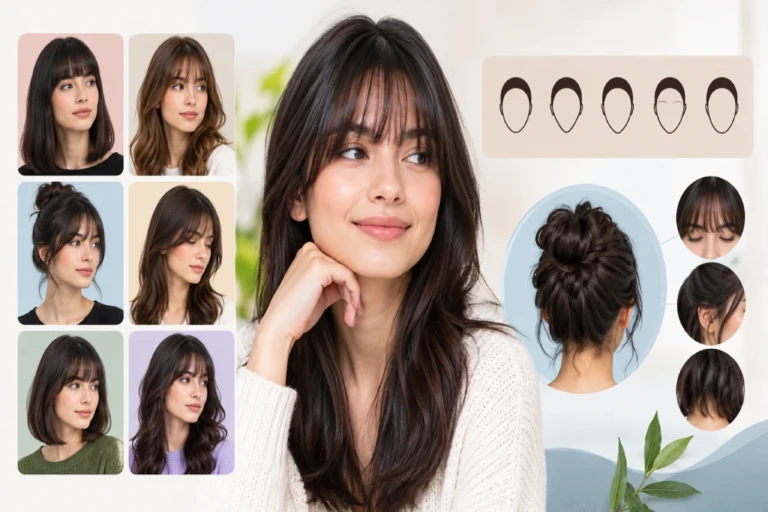
Bangs hair is a section of hair at the front of the head that is cut shorter than the rest, so it falls over the forehead. In the UK and many other places, this is called a fringe. Bangs can be short or long, heavy or light, cut straight across or parted in the middle.
Bangs change how the face is framed. They draw attention to the eyes and cheekbones, soften or sharpen facial features, and give shape to a haircut that might otherwise look flat at the front. They can also make a high forehead look shorter or change the proportions of a hairstyle without cutting the length.
What Is Bangs Hair?
Bangs hair refers to strands cut shorter at the front of the head, usually falling across or around the forehead. They can be cut in different lengths, shapes, and textures to create different looks, from soft and face-framing to bold and defined.
Bangs can be worn with short, medium, or long hair and include styles such as curtain bangs, blunt bangs, wispy bangs, and side-swept bangs. The right style can also be adapted to your hair texture, face shape, and preferred hairstyle.
Different Types of Hair Bangs
Most bangs belong to a few main styles. The difference is in length, density, and where the hair falls. Here is a quick comparison before we look at each one.
| Type of Bangs | Length | Shape | Overall Look |
| Curtain bangs | Cheekbone to jaw | Parted in the center, curving outward | Soft and face-framing |
| Side-swept bangs | Brow to cheekbone | Angled across the forehead to one side | Relaxed and slightly asymmetrical |
| Blunt bangs | At or just above the brows | Straight, solid line | Bold and defined |
| Wispy bangs | Brow length, varies | Thin, separated pieces | Light and airy |
| Birkin bangs | Just past the brows | Full but soft, often slightly parted | Effortless and a little undone |
Curtain Bangs
Curtain bangs are parted in the middle and sweep outward to each side, like a pair of curtains pulled open. The shortest point usually sits near the bridge of the nose, and the hair gets longer toward the cheekbones or jawline.
The parted shape leaves part of the forehead visible, so curtain bangs feel less dramatic than a full fringe. They blend into the surrounding layers, which is why they are one of the most requested types of bangs hair today.
Side-Swept Bangs
Side-swept bangs are cut at an angle and brushed across the forehead to one side. One end is shorter, often near the brow, and the other end blends into the side of the hair.
This style creates a diagonal line across the face instead of a horizontal one. That angle gives the face a softer, less symmetrical frame, and the bangs can be tucked behind the ear or pinned back when you want them out of the way.
Blunt Bangs
Blunt bangs are cut in a straight, solid line, usually at or just above the eyebrows. There is little texturizing at the ends, so the edge looks crisp and heavy.
This is the most defined of the different types of hair bangs. It creates a strong horizontal line that puts the eyes at the center of attention, and it works well when you want a haircut that looks intentional and graphic.
Wispy Bangs
Wispy bangs use less hair and are cut with texture, so the ends separate into fine pieces instead of forming a solid block. You can see some of the forehead through them.
The main difference from fuller bangs is weight. Wispy bangs move easily, look softer at the edges, and feel less like a commitment. They are a common choice for someone trying bangs for the first time.
Birkin Bangs
Birkin bangs fall between a full fringe and curtain bangs. They are long, usually grazing or slightly covering the eyebrows, with enough density to look full but soft ends that keep them from appearing heavy. They often split slightly in the center.
The finish is slightly messy on purpose, as though the hair was not overly styled. Among the best bang hairstyles for a relaxed look, Birkin bangs stand out because they give you the fullness of a fringe without the sharp edge of blunt bangs.
Bangs Hairstyles for Long Hair
Long hair and bangs work well together because the length balances the weight at the front. The bangs frame the face while the long hair adds movement and volume below. Here are a few long hairstyles with bangs that are easy to wear:
- Long layers with curtain bangs: The curtain bangs blend into face-framing layers, creating one continuous line from the forehead down to the shoulders.
- Sleek straight hair with blunt bangs: A heavy, straight fringe paired with smooth, one-length hair gives a clean and polished look.
- Loose waves with wispy bangs: Light bangs pair naturally with soft waves, and nothing looks too heavy or too structured.
- Half-up style with side-swept bangs: Pulling back the top section while leaving angled bangs in front keeps the face visible without losing the frame.
- High ponytail with curtain bangs: The bangs stay out while the rest of the hair is pulled up, so the ponytail looks less severe.
- Voluminous blowout with Birkin bangs: A full, bouncy blowout combined with long, soft bangs creates an easy look with plenty of volume.
Length affects how the final style looks. Bangs on hair that ends at the collarbone look different from bangs on waist-length hair, because the proportion between the fringe and the rest of the hair changes. If you are adding length for one of these looks, a hair extension length chart can help you see where different lengths will fall before choosing.
Best Bang Hairstyles for Different Looks
No single style is best for everyone. The right choice depends on the look you want. Use this as a starting point:
| Desired Look | Bang Styles to Consider | Why They Work |
| Soft and romantic | Curtain, wispy | Rounded edges and light texture keep the frame gentle |
| Bold and striking | Blunt, full, straight-across | A solid line makes a strong visual statement |
| Face-framing | Curtain, long side-swept | They follow the cheekbones and draw attention to the center of the face |
| Effortless and undone | Birkin, wispy | Slightly messy ends look natural with minimal styling |
| Polished and classic | Side-swept, neat curtain | Smooth shapes that look tidy with a round brush or flat iron |
Some bangs can shift between looks. Curtain bangs can look soft when left loose or more polished when blow-dried into a smooth curve. Blunt bangs look sharper on straight hair and more relaxed when the rest of the hair is textured.
How to Choose Bangs for Your Face Shape
Face shape is a useful way to narrow down options, but it is not a strict rulebook. The goal is visual balance. Bangs add lines to the face, and those lines can make a face look shorter, wider, softer, or more angular.
Think of it this way:
- Horizontal lines, like blunt bangs, visually shorten the face.
- Diagonal or curved lines, like side-swept and curtain bangs, soften strong angles and lead the eye downward.
- Light, broken edges, like wispy bangs, add softness without adding weight.
- Longer bangs that end near the cheekbones create a frame that can slim or lengthen the face.
To identify your face shape, pull your hair back and look at the widest part of your face, the shape of your jaw, and the overall length compared with the width. Once you know that, you can compare bang styles the same way you would compare hairstyles for different face shapes: focus on which lines balance your features, not on which style is trending.
Your features, hair texture, and personal style matter just as much as the shape itself. Many people wear bangs that don’t match the typical recommendation and look great in them.
Bangs for Different Face Shapes
Here is a simple guide to bang styles that may complement each face shape:
| Face Shape | Bang Styles to Consider |
| Oval | Curtain, wispy, blunt, and side-swept bangs |
| Round | Curtain, side-swept, and longer face-framing bangs |
| Square | Wispy, curtain and softer side-swept bangs |
| Heart | Curtain, wispy and side-swept bangs |
| Long | Blunt, full and curtain bangs |
Oval: Balanced proportions mean most styles work. The choice comes down to the look you want.
Round: Bangs that part or angle away from the center, and fall past the cheekbones, create vertical lines that can make the face look slightly longer. Very short, heavy bangs can make a round face look wider.
Square: A strong jaw and forehead benefit from softness. Textured or curved bangs soften the angles, while a sharp, blunt line may emphasize them.
Heart: A wider forehead and narrower chin pair well with bangs that cover part of the forehead and curve toward the cheeks, drawing attention to the middle of the face.
Long: Fuller bangs reduce the length of the forehead and create horizontal balance. Blunt bangs and curtain bangs both work well here.
Choosing Bangs Based on Your Hair and Style
After face shape, consider what your hair naturally does and how much time you want to spend on it.
Hair length
- Short hair works best with bangs that blend into the cut, such as wispy or side-swept styles.
- Medium and long hair can support any style, including heavier blunt or Birkin bangs.
Hair texture
- Fine hair: Wispy or curtain bangs keep the front from looking thin. Very heavy bangs may take too much hair from the rest of the style.
- Thick hair: Blunt and Birkin bangs hold their shape well. Your stylist may thin them slightly to prevent puffiness.
- Wavy hair: Curtain and Birkin bangs work with natural movement instead of against it.
- Curly hair: Curly bangs are usually cut dry and slightly longer, as curls shrink. Curtain and full curly fringes are popular choices.
Styling time
- Low effort: Birkin, wispy, and curtain bangs look fine air-dried or slightly messy.
- Moderate effort: Side-swept bangs need a quick blow-dry to fall in the right direction.
- Higher effort: Blunt bangs look best when smooth and straight, so they usually need daily styling and regular trims.
Other factors
- A cowlick at the hairline can make blunt bangs difficult. Curtain or side-swept bangs usually handle it better.
- If you’re unsure about committing, start with long curtain bangs. They grow out easily into face-framing layers.
FAQs About Bangs Hair
What is the difference between bangs and a fringe?
Nothing. “Bangs” is the common American term, and “fringe” is the British term for the same cut.
Which type of bangs is easiest to maintain?
Curtain and Birkin bangs are generally the easiest. They are longer and softer, so a slightly grown-out stage still looks good.
Can I get bangs if I have curly hair?
Yes. Ask your stylist to cut them dry and a little longer than your target length, as curls spring up once they dry.
Do bangs suit long hair?
Yes. Long hair balances the weight of bangs well, and almost every bang style can be paired with long hair.
What bangs look good on a round face?
Curtain bangs, side-swept bangs, and longer face-framing bangs are common choices because they create vertical or diagonal lines.
How often do bangs need trimming?
Blunt bangs usually need a trim every three to four weeks. Wispy and curtain bangs can often go six weeks or longer.
Are bangs a good idea for a first-time change?
Wispy or long curtain bangs are a safe start. They are easy to style and grow out without an awkward phase.
Find a Bang Style That Fits Your Look
Your ideal bangs depend on more than a trend. Consider your face shape, hair length, natural texture, and how much styling you want to do each day. Whether you prefer soft curtain bangs, a defined fringe, or a lighter wispy look, the right style should work naturally with your overall hairstyle.
If you’re planning to switch up your look with extensions or a new hairstyle, explore hair extensions at The NiCa Collection and find options that complement your desired style.
Share this Article
Facebook
LinkedIn
WhatsApp
Email
Print
Latest Posts
Find the perfect hair for your next look?
Explore a curated selection of premium extensions and wigs from trusted vendors on NiCa Collection.
Read Related Blog
Knotless vs Box Braids: Difference, Lasting Time, Comfort and Style
October 13, 2026
The main difference between knotless vs box braids comes down to how each style starts at the root. Box braids start with a small knot that secures the extension hair
Difference Between 3C and 4A Hair: Types, Texture & Styles
October 8, 2026
If you’ve ever looked at a curl chart and felt like your hair belongs in two boxes at once, you’re in good company. 3C and 4A sit right next to
Bridal Hair Styles: Types, Wedding Ideas & Styling Tips
September 28, 2026
The right bridal hairstyle is not the one saved most often on Pinterest. It is the one that works with your dress, your actual hair, your venue, and the number