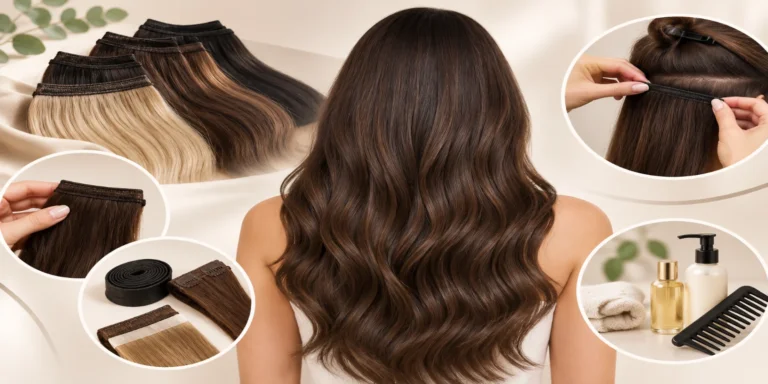
If you have spent any time researching hair extensions, you have run into the term weft hair. A weft is a row of hair strands joined together along one edge so they form a continuous strip rather than loose individual pieces. That strip is what gets attached to your natural hair.
Weft hair sits behind most sew-in installs and a large share of bead-based methods too. One weft covers an entire row, which is why stylists reach for it when a client wants noticeable length or fullness without working through dozens of tiny sections.
How that strip is built matters more than most people expect. It affects how flat the hair lies, which attachment methods your stylist can use, how it feels day to day, and how much upkeep it needs. This guide covers the main types, installation, care, and how to pick the option that suits your hair.
What is Weft Hair?
Weft hair is hair gathered and secured along a base, producing a long strip with hair falling from one side. Think of a curtain: the top edge holds everything in place and the hair hangs freely below it. That top edge, the weft or track, is made by machine stitching or by hand, and it holds the strands in a fixed row so the whole section can be attached at once.
That is the practical difference between wefts and individual extension strands. With strand-by-strand methods, each small bundle is bonded, taped or clamped separately, so a full head can involve well over a hundred attachment points. A weft delivers the same coverage across a single row.
Wefts are used in sew-ins, bead-based installs, clip-in sets and many wig constructions, in straight, wavy, curly and coily textures across a wide range of lengths and colours.
What Does Weft Hair Mean?
In practical terms, weft hair meaning comes down to construction rather than quality or origin. The word describes how the hair is assembled, nothing more. Two wefts can contain very similar hair and still behave differently because the base is built in a different way.
How Does Weft Hair Work?
The sequence is straightforward: hair strands are secured to a base, the base is attached to your natural hair in rows, and your own hair is left out over the top to cover the tracks and blend everything. Because the hair arrives as a continuous section, a weft gives you:
- Coverage across a full row rather than a small cluster
- Volume that builds evenly as rows are added
- Length you can adjust by placing wefts higher or lower on the head
- Blending that depends on leaving out enough of your own hair above each track
Attachment is the part that varies. The same weft might be sewn onto a braided base, secured to small beads, or clipped in temporarily.
Types of Weft Hair
Weft types come down to two constructions: machine weft and hand-tied weft.
Machine Weft Hair
Machine weft hair is sewn onto a base by machine, producing a firm, evenly stitched track that runs the full length of the weft.
- The track is sturdy and holds its structure
- Hair is generally packed densely along the base
- The weft can usually be cut and sealed, so a stylist can size sections to your head
- The base sits slightly thicker than a hand-tied track
Machine wefts are widely used for sew-ins and are a common pick for substantial fullness. The stitching handles repeated washing well, though longevity always depends on hair quality and treatment. They are also easier to find and more affordable, which matters when you are buying several bundles.
Hand-Tied Weft Hair
Hand-tied weft hair is knotted onto the base by hand, one small section at a time, giving a thinner and flatter track.
- The base has a low profile, so it sits closer to the scalp
- Root movement often looks softer because the track is less bulky
- The weft bends easily around the curve of the head
- It usually cannot be cut freely without unravelling
That last point matters for planning, since hand-tied wefts often go in as complete rows or need professional finishing at the ends, which affects appointment length and cost. The thin base makes them a frequent choice for bead-based methods and for a flatter finish near the crown or hairline.
Machine Weft vs Hand-Tied Weft
| Feature | Machine Weft | Hand-Tied Weft |
| Construction | Machine-stitched track | Knotted by hand onto the base |
| Thickness | Thicker, structured track | Thin, low-profile track |
| Flexibility | Firm, holds its shape | Softer, bends around the head |
| Appearance | Fuller through the track area | Flatter at the root |
| Durability | Stitched base resists handling well | Needs careful handling to avoid unravelling |
| Best suited for | Sew-ins and higher-volume looks | Flat installs, finer hair |
| Installation | Can usually be cut and sealed to size | Often installed in full rows |
Neither construction wins in every situation. A hand-tied weft on hair that cannot support it will disappoint, and a machine weft used skilfully on hair that suits it can look excellent. Your density, your goal, and your stylist’s method decide the answer.
Benefits of Weft Hair Extensions
- Length without a separate attachment for every strand – Rows go in faster than individual bonds.
- Even volume – Hair is distributed along a track, so fullness builds consistently instead of in patches.
- Texture options – Straight, body wave, deep wave, curly and coily wefts are widely available, which makes matching your natural texture realistic.
- Styling range – Once blended, weft hair can usually be styled much like your own, within the limits of the hair type.
- Method flexibility – The same format works across sew-in, bead-based and clip-in installs.
- Possible reuse – Carefully removed wefts can often be reinstalled if the hair is still in good condition.
The trade-off is upkeep. Rows need tightening or repositioning as your natural hair grows, and the scalp underneath needs proper attention.
How Is Weft Hair Installed?
Most weft hair installation methods are best handled by a trained stylist. Sew-ins and bead-based installs involve tension control, correct row placement, and secure finishing, and errors there can cause discomfort or stress on your natural hair.
Preparing the Natural Hair
- Wash and clarify so the scalp starts clean
- Detangle fully before sectioning begins
- Assess condition honestly, since fragile hair may need attention first
- Plan placement so rows sit where your own hair can cover them
- Choose a construction that matches your density and method
Common Weft Installation Methods
Sew-in – The natural hair is braided into cornrows, and the weft is stitched onto the braids with a needle and thread. This is the traditional approach and pairs well with machine wefts.
Bead-based installs – Small beads are clamped onto sections of natural hair as anchor points, and the weft is secured to them. No braiding is involved, which suits flatter constructions like hand-tied wefts. For the full process, our Microlink hair extension installation guide walks through the microbead weave method step by step.
Clip-in wefts – Clips are attached to the track so the hair goes in and out at home. This is the one weft format genuinely designed for self-installation.
Hybrid approach – Some stylists combine beads with stitching for extra security, which is a conversation to have in the chair.
How Long Does Weft Installation Take?
Any figure quoted online is one stylist’s average. Timing shifts with your hair density and length, the number of wefts, the method, the coverage you want, and the stylist’s experience with that method. A two-row partial install is a far shorter appointment than a full head with a closure, so ask for an estimate when you book.
How Many Weft Bundles Do You Need?
Ordering short is a frustrating way to start, and this is where first-time buyers get caught out. The amount depends on:
- Length – since longer hair covers less width per bundle
- Desired fullness – as a soft finish needs fewer bundles than a very full look
- Head size – because larger circumferences need more coverage per row
- Your own density – since fine hair needs more added volume to look balanced
- Installation method – as row spacing differs
- Closure or frontal use – which changes how much your wefts must cover
For a breakdown by length and install type, read our guide on how many bundles you need for a full head before ordering.
How to Care for Weft Hair
None of this is complicated, but it does need consistency.
Washing Weft Hair
Use sulphate-free shampoo and a conditioner suited to the hair type. Concentrate shampoo on the scalp and tracks, then let the suds run through the lengths instead of scrubbing. Rinse thoroughly, since product left around the tracks causes buildup and itching, and dry the tracks fully.
Detangling Weft Hair
Start at the ends and work upward in small sections, holding the hair above the point you are brushing so you are not pulling at the attachments. A wide-tooth comb or loop brush is gentler than a standard brush.
Heat Styling
Apply heat protectant every time and keep temperatures moderate. Extension hair does not repair itself the way growing hair does, and curly or coily textures need a lighter hand.
Sleeping With Weft Hair
Use a satin or silk bonnet, scarf, or pillowcase, and loosely braid or tie the hair to cut overnight friction. Avoid sleeping with wet hair, especially around the tracks.
Preventing Tangling and Shedding
Tangling usually comes from dryness, friction, and skipped detangling. Shedding at the track is often a loosened stitch or a bead needing attention. Keep the hair moisturised, detangle before and after washing, and book maintenance before rows grow out.
How Long Does Weft Hair Last?
Lifespan varies too much for a single number to be honest. What actually determines it:
- Quality and processing of the hair itself
- Installation method and how well it was executed
- Consistency of your care routine
- Wash frequency and the products used
- How much heat styling the hair sees
- How gently it is handled day to day
- Whether removal is careful enough for the wefts to be reused
Two people can buy identical wefts and get very different results purely from maintenance habits.
Weft Hair vs Other Hair Extensions
Weft Hair vs Clip-In Extensions
Clip-ins are wefts with clips attached, so the format is identical. The difference is commitment: clip-ins go in and out at home in minutes and suit occasional wear, while sewn or beaded wefts stay in for weeks and give a more integrated result with less daily effort.
Weft Hair vs Tape-In Extensions
Tape-ins use adhesive strips sandwiched around your hair and lie very flat, which makes them popular for fine hair. They need refitting on a short cycle and rely on adhesive that oils can affect. Wefts give more volume per attachment point and no adhesive.
Weft Hair vs Individual or Strand Extensions
Strand methods such as I-tips and keratin bonds allow precise placement and plenty of movement, but appointments are long, and removal is detailed. Wefts install faster and add volume more efficiently, with less control over each piece.
How to Choose the Right Weft Hair
Texture – Match the weft to your natural texture as closely as you can. Blending is far easier when you are not fighting the hair’s natural behaviour.
Length – Consider your current length as well as your target. A large jump needs enough hair to avoid a visible step where your own hair ends.
Volume – Fine hair supports a limited amount of added weight, and overloading it creates tension problems rather than fullness.
Construction – Machine wefts suit sew-ins and fuller looks; hand-tied wefts suit flatter installs and finer hair. Let the install method guide the choice.
Quality – This decides whether the hair still looks good in month three. Cuticle alignment, processing, and consistency matter more than price alone. Our guide on how to choose high-quality hair extensions covers what to question before buying.
Frequently Asked Questions About Weft Hair
What is weft hair?
Hair secured along a base to form a continuous strip, which is then attached to natural hair in rows.
What does weft hair mean?
The term describes construction, not origin or quality. The hair is assembled into a track rather than supplied as loose strands.
What are the different types of weft hair?
Machine weft and hand-tied weft. Clip-in wefts are a variation with clips added to the track.
What is machine weft hair?
Hair sewn onto a base by machine, creating a firm, densely packed track that can usually be cut and sealed to size.
What is hand-tied weft hair?
Hair knotted onto the base by hand, giving a thinner, flatter track that generally cannot be cut freely.
Is hand-tied weft better than machine weft?
Neither is universally better. Hand-tied suits flat installs and finer hair; machine weft suits sew-ins and fuller looks.
How is weft hair installed?
Usually by sew-in or bead-based methods performed by a stylist. Clip-in wefts are the exception, made for at-home use.
How long does weft hair last?
It depends on hair quality, install method, care routine, heat use and handling, so there is no reliable universal figure.
Can weft hair be reused?
Often yes, if removal is careful and the hair is still in good condition. Rough removal is the usual reason wefts cannot be reinstalled.
How do you maintain weft hair extensions?
Wash gently with sulphate-free products, dry the tracks, detangle from the ends upward, protect the hair at night, limit heat, and keep up with maintenance appointments.
Choosing Weft Hair With Confidence
Weft hair is hair joined along a base so it can be installed in rows instead of individual pieces. Machine wefts give a sturdy, fuller track suited to sew-ins. Hand-tied wefts give a flatter finish that works well with bead-based installs and finer hair. Both work, so the real question is which suits your hair and your chosen method.
Beyond construction, results come down to matching texture and length sensibly, being realistic about the volume your hair can carry, working with a stylist who knows the method, and keeping to a care routine once the hair is in.
When you are ready to compare options, The NiCa Collection is a curated marketplace connecting customers and stylists with vetted hair-extension and wig vendors, matching products by type, length, colour and texture. It is a practical place to explore hair extensions and wigs and find a weft that fits what you want to achieve.
Share this Article
Facebook
LinkedIn
WhatsApp
Email
Print
Latest Posts



Find the perfect hair for your next look?
Explore a curated selection of premium extensions and wigs from trusted vendors on NiCa Collection.
Read Related Blog
3A vs 3B vs 3C Curls: Key Differences You Should Know
August 19, 2026
The difference comes down to curl size and tightness. 3A curls are loose and large, roughly the width of a piece of sidewalk chalk. 3B curls are tighter and springier,

Easy and Stylish Hair Styles for Short Hair Women
August 18, 2026
Short hair has a way of making life simpler. No more wrestling with tangles at 7 AM. No more heavy ponytails after a long day. Just a clean, confident style
Knotless Braids: Types, Hairstyles & Different Ways to Style
August 17, 2026
Knotless braids have quietly taken over the protective styling world, and it isn’t hard to see why. They sit flatter at the root, move more like natural hair, and skip