Knotless braids have quietly taken over the protective styling world, and it isn’t hard to see why. They sit flatter at the root, move more like natural hair, and skip the small bump that traditional braids leave where the extension is first attached. The result is a style that photographs beautifully and feels lighter to wear day-to-day.
This guide covers what knotless braids actually are, the sizes and lengths you can choose from, the hairstyles people are asking their braiders for, and practical ways to style and care for them once they’re in. If you’re deciding between styles for your next appointment, everything you need to make the call is below.
What Are Knotless Braids?
Knotless braids are a braiding technique where the braid begins with your own hair rather than with a knot of extension hair wrapped around it. The braider starts a small three-strand braid using only your natural hair, then gradually feeds in thin pieces of extension hair as the braid moves down. Each addition is small, so the braid builds up thickness slowly rather than all at once.
Traditional box braids work differently. The braider anchors the extension hair to the base of the section with a knot, then braids down from there. That knot creates the fuller, more defined root that box braids are known for, along with a slightly raised bump at the scalp.
The difference shows up in three places:
- At the root – Knotless braids lie flat against the scalp with no visible knot.
- In the movement – Because the weight is distributed down the length rather than concentrated at the base, knotless braids swing more freely.
- In the finish – The gradual feed-in makes the transition from natural hair to extension hair harder to spot.
Neither technique is a replacement for the other. Box braids give you a bolder, more sculptural root and often hold their shape longer at the parting. Knotless braids give you a softer, more natural-looking start.
What Are the Benefits of Knotless Braids?
The benefits of knotless braids come down to how the weight is distributed and how the style behaves once it’s installed.
A lighter feel at the scalp – The braid starts thin and thickens gradually, so there’s less bulk sitting directly on your roots. Many people describe the first few days as noticeably more comfortable than a fresh set of knotted braids.
Natural-looking roots – With no knot at the base, the parting reads cleaner and the braids blend into your own hair more convincingly.
More styling freedom, sooner – Flat roots mean you can pull braids into a ponytail or bun without a row of knots creating lumps under the style. You can also part them in more directions.
Less bulk overall – Smaller sections and gradual feed-in keep the style from looking heavy at the crown, which suits finer natural hair particularly well.
Versatility across sizes and lengths – The technique works for micro braids, jumbo braids, waist-length styles, and bob-length ones equally well.
One honest caveat: knotless braids are often described as tension-free or damage-free, and that isn’t accurate. Any braided style pulls on your hair to some degree. A braider who parts too tightly, uses too much extension hair, or installs braids longer and heavier than your natural hair can comfortably support can still cause breakage or soreness at the hairline. The technique reduces the load; it doesn’t remove it. How the braids are installed and how you care for them matters more than the technique alone.
Types of Knotless Braids
Most of the choice comes down to two variables: how thick each braid is, and how long the finished style falls. Those two decisions shape everything else: installation time, weight, styling options, and how often you’ll need to refresh the roots.
Medium Knotless Braids
Medium knotless braids are roughly the width of a pencil at the base, give or take. This is the size most people land on, and for good reason.
They install in a reasonable window, usually a few hours rather than a full day, and they’re light enough to gather into a high ponytail without straining your edges. There’s enough definition for the braids to read as intentional, and enough of them to allow different parting patterns.
Medium braids suit you if you want one style that handles work, the gym and a night out without needing much thought.
Short Knotless Braids
Short knotless braids typically fall somewhere between chin and shoulder length. Bob-length knotless braids have become a favourite for anyone who wants the protective benefit of braids without the weight of a long style.
What makes them practical:
- Less overall weight, which reduces pull on the scalp
- Faster to install than waist-length versions
- Easy to sleep in and easier to wrap at night
- They dry quickly after washing
The trade-off is fewer updo options. Very short braids won’t gather into a full bun, though a half-up style or a small clipped section works well.
Large Knotless Braids
Large or jumbo knotless braids use thicker sections and fewer braids overall. They install quickly, often in half the time of a medium set, and the finished look is bold and sculptural.
Two things to keep in mind. First, thicker braids mean more extension hair concentrated in each section, so a long jumbo style can carry real weight. Second, larger sections mean larger partings, which some people love, and others find too exposed at the scalp.
Large braids work well as a short-term style, for a quick refresh, or when you want maximum impact with minimum chair time.
Popular Knotless Braids Hairstyles
Here are the knotless braids hairstyles worth bringing to your braider as reference.
Classic Knotless Box Braids
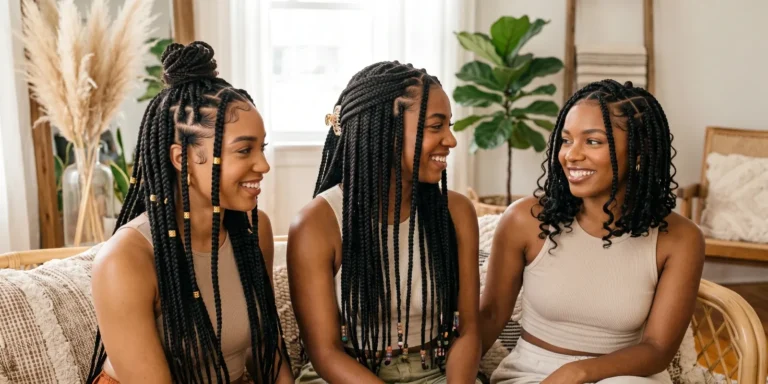
Square or rectangular partings, uniform braid size, worn loose. Knotless box braids hairstyles keep the geometric parting that makes box braids recognisable, but swap the knotted base for a fed-in one. It’s the most requested version of the style, and the easiest to build other looks from.
Knotless Braids With Curls
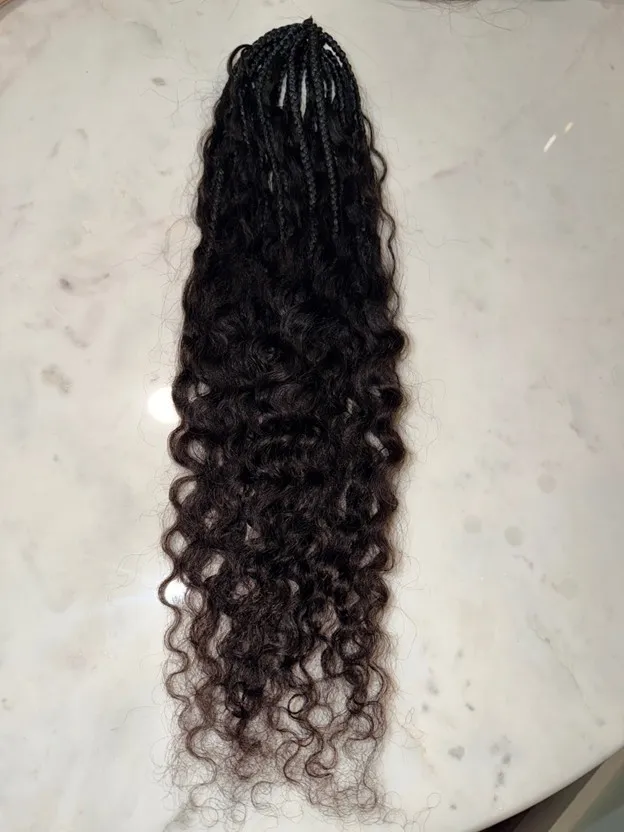
Knotless braids with curls leave the last few inches of each braid unbraided and curled either with curly extension hair or by setting the ends in hot water with perm rods. The curls add movement and soften the overall shape, and they hide any slight unevenness at the ends. This is also called a “goddess” or “bohemian” finish when curly pieces are left loose along the length rather than only at the tips.
Half-Up, Half-Down Knotless Braids
Gather the top half into a ponytail or bun and leave the rest falling. It keeps hair off your face while showing off the length, and it takes about a minute to do. Works best with medium or long braids.
High Ponytail With Knotless Braids
Longer braids gather neatly into a high ponytail, and the flat roots mean the base sits smoothly with no lumps. Wrap one braid around the elastic to hide it. Keep the ponytail loose enough that you can’t feel pulling at your temples; a high, tight pony is where a lot of edge stress comes from.
Knotless Braids in a Bun
Twist the ponytail around itself and pin it for a sleek high bun, or leave a few braids loose around the face for a relaxed version. A low bun at the nape puts less strain on the hairline than a high one, which makes it a good choice for days when your scalp feels sensitive.
Side-Swept Knotless Braids
Sweep the whole set over one shoulder and secure with a couple of pins at the opposite side. It changes the shape of the style completely without any real effort, and it’s a simple way to make a set that’s been in for three weeks look fresh again.
Different Ways to Style Knotless Braids
Beyond specific hairstyles, a few small changes will get you a lot of mileage out of one install.
Accessorize With Hair Cuffs and Beads
Gold or silver cuffs, wooden beads, and thread wraps all work. The trick is restraint: placing accessories on a scattered handful of braids rather than every one keeps the look considered instead of cluttered. Beads add weight, so use them sparingly on longer styles and cluster them toward the middle of the braid rather than the very ends where they’ll swing hardest.
Try Different Parts
Since there’s no knot at the base, knotless braids sit convincingly in almost any direction. Move from a middle part to a deep side part for an instant change, or ask your braider for a zig-zag or triangle parting pattern at install for something more distinctive. A side part also gives you extra volume on the heavier side.
Add Curls or Wavy Ends
You don’t have to commit to curls at installation. Braided ends can be dipped in hot water and set on perm rods later, which gives you two looks from one install. Loose waves through the ends read softer than tight curls and take less time to set.
Create Updos and Ponytails
Space buns, a low chignon, two braided pigtails, a half-up top knot, and longer braids are essentially a set of building blocks. Watch the weight: a full updo pulls the entire load of the style toward one point, so alternate updo days with days where the braids hang loose.
How to Do Knotless Braids
The technique looks simple and takes real practice to do cleanly. Here’s what the process involves:
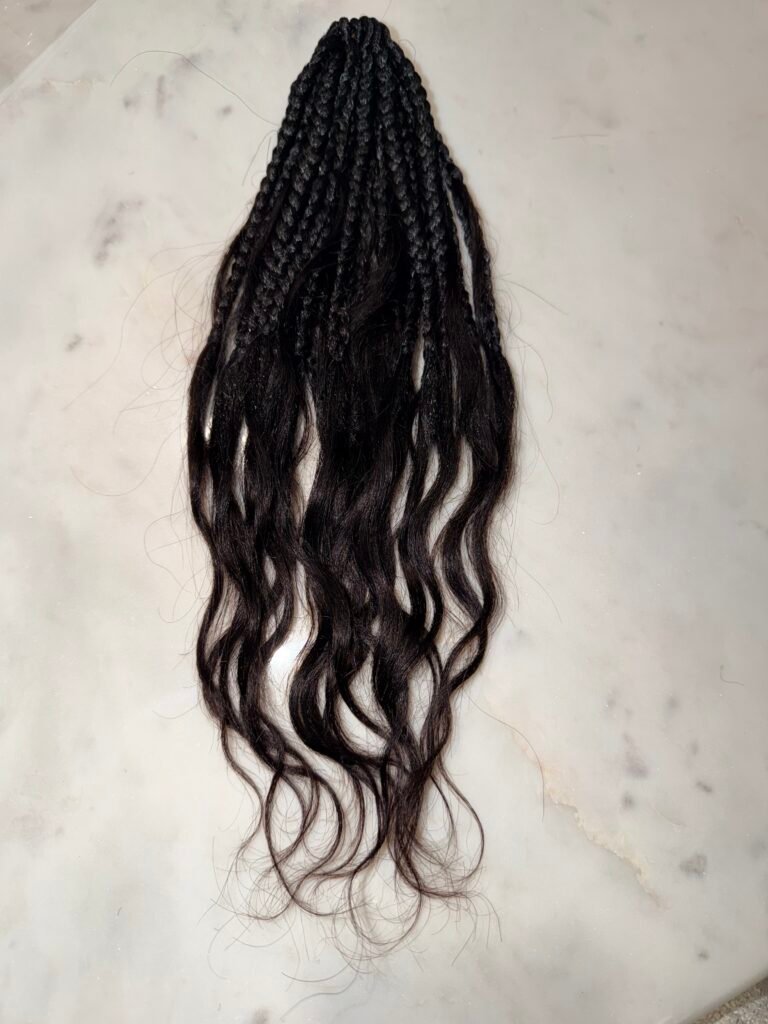
- Prep the hair – Wash, condition, and fully detangle. Blow-drying or stretching the hair first makes sectioning far easier and the braids smoother.
- Section the hair – Part out a clean section in the size you want and clip the rest away. Consistent parting is what makes the finished style look professional.
- Prepare the extension hair – Separate the braiding hair into small, graduated pieces ahead of time: a few very thin ones to start, then progressively larger. Preparing these in advance is what keeps the feed-in smooth.
- Start with natural hair only – Split the section into three strands and begin a normal three-strand braid using just your own hair for two or three passes.
- Feed in gradually – Add the smallest piece of extension hair by folding it over one strand and continuing the braid. Add the next piece a pass or two later, then the next, until the braid reaches the thickness you want.
- Braid down to length – Continue until you reach the end of the extension hair, keeping tension even and consistent.
- Seal the ends – Dip synthetic ends in hot water to set them, or use a small elastic. For curled ends, set on rods before dipping.
If you’re new to braiding, start with a few practice sections at the back of your head where mistakes are less visible. Long, small or heavily accessorised sets are worth booking with a professional; an experienced braider controls tension far better than a beginner working on their own head, and even parting is genuinely difficult to do without help.
It’s also worth knowing that braiding is one of several ways to add length or volume. Sew-ins, clip-ins, and microlinks all attach differently and suit different hair goals, and reading up on different hair extension installation methods can help you decide whether braids are the right choice for the result you’re after.
How to Choose the Right Knotless Braids
Work through these five questions before your appointment:
How much time do you have? Small braids can take eight hours or more. Large braids might take three. Be realistic about sitting still.
How long do you want to keep them? Smaller braids hold up longer before the roots look grown out. If you want a style for two weeks, larger braids make more sense.
What’s your natural hair density? Finer or more fragile hair generally does better with lighter, shorter braids and smaller sections that don’t pull. Denser hair can carry more length and weight comfortably.
What will you actually do in them? Daily gym sessions and swimming favour shorter, lighter styles. If you mostly wear your hair down, length is less of a problem.
Which styles do you want access to? Buns and high ponytails need enough length to gather. If those are non-negotiable, don’t go shorter than shoulder length.
The hair you use matters as much as the size you pick. Extension hair varies widely in texture, weight, fibre quality, and how it holds up to washing, and cheaper hair is often heavier and more prone to tangling, which puts extra strain on your natural hair. It’s worth understanding how to choose high-quality hair extensions before you buy for a style you’ll be wearing for weeks.
How to Care for Knotless Braids
Good care is what determines whether you take the style out with healthy hair underneath.
Keep the scalp clean – Dilute a gentle shampoo with water in an applicator bottle and apply it directly to the scalp every two to three weeks. Massage with your fingertips, rinse thoroughly, and don’t scrub the length of the braids; that’s what causes frizz.
Moisturise regularly – A light leave-in spray or a few drops of a lightweight oil on the scalp keeps things comfortable. Heavy creams and butters build up quickly in braids and are hard to rinse out.
Protect them at night – A satin or silk bonnet, scarf or pillowcase reduces friction and keeps frizz down. This single habit makes the biggest difference to how long the style looks fresh.
Dry them properly – Damp braids left to sit can start to smell. Squeeze out excess water with a microfibre towel and let them air dry fully, or use a blow dryer on cool.
Be gentle with tension – Skip tight ponytails in the first few days. If your scalp feels sore, loosen whatever style you’re wearing rather than pushing through it.
Know when to take them out – Don’t stretch a set past its useful life to save an appointment. When the roots have grown out enough that the braids feel loose and the style is slipping, it’s time.
Remove them carefully – Cut off any sealed ends, unravel each braid from the bottom, and detangle with conditioner and patience. Rushing removal undoes weeks of careful wear.
How Long Do Knotless Braids Last?
Most people keep knotless braids in for four to six weeks, and some stretch to eight. But the range is wide, and it depends on several things:
- Braid size – Smaller braids stay neat longer than jumbo ones.
- Your growth rate – Faster growth means visible new growth sooner.
- Installation quality – Even tension and clean parting hold up better than rushed work.
- Your routine – Frequent swimming, heavy sweating, and daily restyling all shorten the lifespan.
- Night care – Bonnet-wearers consistently get more weeks out of a set.
The more important question is when to take them out rather than how long they can technically last. Leaving braids in past the point where roots have grown out and matted makes removal harder and increases breakage. Six to eight weeks is a sensible ceiling for most people, and giving your hair a week or two of rest between sets is a good habit.
Common Knotless Braids Mistakes to Avoid
- Accepting too much tension – If it hurts during installation, say so. Pain isn’t part of the process, and a braider who won’t loosen up isn’t the right braider.
- Using too much extension hair – Overloaded braids are heavy braids, and weight is the main cause of stress at the hairline.
- Buying the cheapest hair available – Low-quality fibre tangles, sheds, and often feels heavier than better hair of the same length.
- Skipping scalp care – Buildup, itching, and flaking are avoidable with a simple wash routine.
- Keeping them in too long – Every extra week past the point of grown-out roots makes removal harder.
- Styling roughly – Yanking braids into tight styles, sleeping without protection, and pulling through tangles all add up.
- Going straight into a second set – Give your hair a break before reinstalling.
Frequently Asked Questions About Knotless Braids
- What are knotless braids?
Knotless braids are a feed-in technique where extension hair is gradually added to your natural hair, creating flat, natural-looking roots without a knot. - Are knotless braids better than traditional box braids?
Neither is better for everyone. Knotless braids are lighter and flatter, while traditional box braids offer a fuller root and may last longer. - What are the benefits of knotless braids?
They offer natural-looking roots, less scalp bulk, more movement, and easier styling into ponytails and buns. - How do you do knotless braids?
Start braiding your natural hair, then gradually feed in small pieces of extension hair as you braid down to the desired length. - How long do knotless braids last?
Knotless braids typically last four to six weeks, though proper care and installation can help them last up to eight weeks. - What are the best knotless braids hairstyles?
Popular options include knotless box braids, high ponytails, buns, half-up styles, side-swept braids, and curled ends. - Can you do knotless braids with curls?
Yes. You can add curls to the ends or throughout the braids using curly extensions, perm rods, or other curling methods. - Are medium knotless braids easier to style?
Yes. Medium knotless braids offer a good balance of weight, styling flexibility, installation time, and longevity. - Are short knotless braids good for everyday wear?
Yes. Short knotless braids are lightweight, easy to maintain, dry faster, and work well for everyday wear. - How should you care for knotless braids?
Wash your scalp every two to three weeks, moisturise lightly, dry your braids fully, avoid tight styles, and protect them with a satin bonnet or scarf at night.
Find the Right Hair for Your Next Braided Style
Knotless braids give you a genuinely flexible protective style on install, and you have box braids, ponytails, buns, half-up looks, and curled ends available depending on the day. Picking the right size and length for your hair and routine is most of the work, and treating your scalp well while the braids are in is the rest.
The hair you braid with is the part people most often rush, and it shows up later in how the style hangs, how it washes, and how it feels after week three. If you’re getting ready for your next set, explore hair extensions through The NiCa Collection, a curated marketplace where you can compare textures, lengths, and quality before you commit to a style you’ll be wearing for weeks.


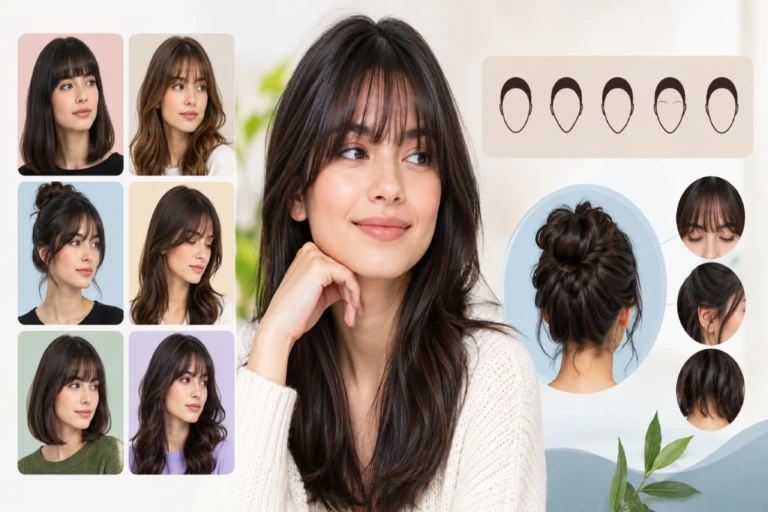
Bangs Hair: Types, Hairstyles and Face Shape Guide
Bangs hair is a section of hair at the front of the head that is cut shorter than the rest, so it falls over the forehead. In the UK and
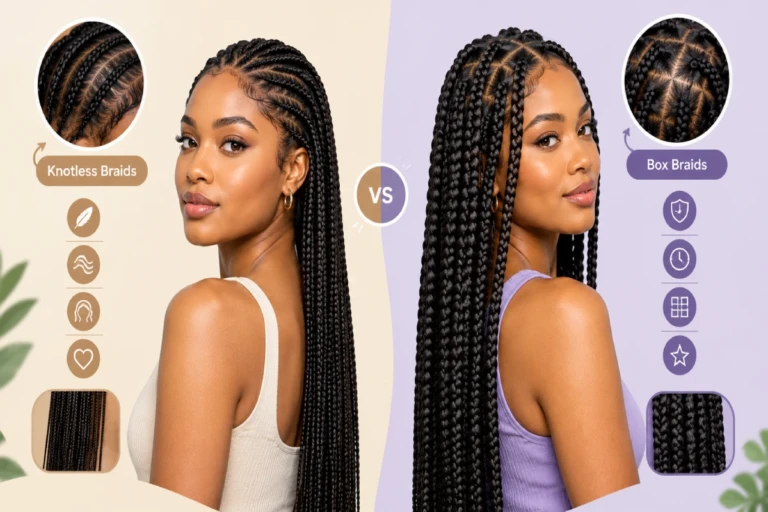
Knotless vs Box Braids: Difference, Lasting Time, Comfort and Style
The main difference between knotless vs box braids comes down to how each style starts at the root. Box braids start with a small knot that secures the extension hair
Difference Between 3C and 4A Hair: Types, Texture & Styles
If you’ve ever looked at a curl chart and felt like your hair belongs in two boxes at once, you’re in good company. 3C and 4A sit right next to