
What Every Hair Buyer Needs to Know Before Their Next Purchase
If you’ve ever opened a bundle or unboxed a unit and noticed shorter strands scattered throughout, strands lifting away from the hair, or both, you’ve probably lumped them together under one frustrated thought:
“Something is wrong with this hair.”
Sometimes you’re right. Sometimes you’re not.
And the difference between those two outcomes matters far more than most consumers realize because misreading what you’re seeing can lead you to return perfectly authentic hair, or worse, keep hair that was never going to perform.
The hair industry uses these terms loosely, vendors rarely explain them, and most buyers are left guessing.
So let’s clear it up completely.
There are three distinct things happening when you see “problem” strands in your hair. They have different causes, different meanings, and different implications for quality. Understanding each one changes how you shop, what you accept, and what you send back.
SHORT HAIRS: THE STARTING POINT
Short hairs are exactly what they sound like — strands within a bundle or unit that are noticeably shorter than the advertised length.
A 24-inch bundle may contain strands that are:
• 24 inches
• 20 inches
• 16 inches
• Or even shorter
Many consumers assume every strand in a bundle should be identical in length.
But that expectation is built on a misunderstanding of how human hair actually works.
Hair grows in cycles. At any given moment, the strands on a donor’s head are in different stages — some actively growing, some resting, some preparing to shed naturally.
When hair is collected from a real donor, that variation is part of what comes with it.
Short hairs, in and of themselves, are not a defect.
They are a starting point for a more important question:
Why are they short?
The answer to that question is everything.
RETURN HAIRS: A SIGN OF AUTHENTICITY
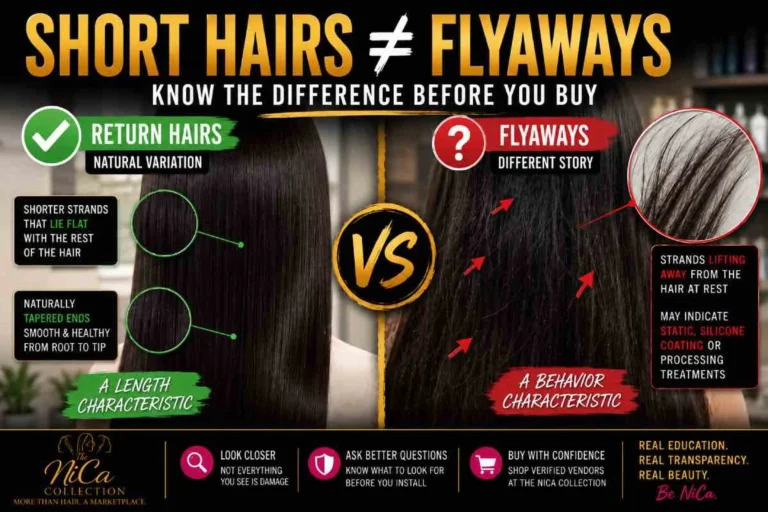
Return hairs are shorter strands that occur naturally within a bundle because human hair doesn’t grow uniformly.
They sit within the weft, lie flat with the rest of the hair, and feel smooth and healthy from root to tip. Their ends are naturally tapered — not blunt, not frayed, and not rough at the break point.
Return hairs are most common in:
• Raw hair
• Single-donor hair
• Minimally processed hair
Precisely because that hair hasn’t been aggressively sorted, blended, or manipulated to create a uniform appearance.
Here’s where it gets counterintuitive:
Some of the most authentic, highest-performing hair on the market contains visible return hairs.
The bundles with zero variation — every strand identical in length, perfectly blunt at the ends — are sometimes the ones that should raise questions.
That level of uniformity is often manufactured, not natural.
It can be the result of heavy sorting, blending, and processing designed to create a cosmetically perfect appearance rather than a genuinely high-quality product.
Return hairs are a length characteristic.
They tell you where the hair came from.
In many cases, they are evidence of authentic sourcing — not a reason to return the product.
FLYAWAYS: A DIFFERENT CONVERSATION ENTIRELY
This is where many consumers make the most costly mistake — confusing flyaways with return hairs and treating them as the same issue.
They are not.
Flyaways are a behavior characteristic, not a length characteristic.
They are strands that actively lift away from the hair shaft, separate from neighboring strands, or refuse to lie flat when the hair is otherwise at rest.
You’re not touching the hair.
Nothing is disturbing it.
And yet strands are lifting and separating.
That behavior is often related to static electricity.
In hair extensions, significant flyaways at rest — particularly when combined with other indicators — may warrant further evaluation for silicone coating, excessive processing, or other manufacturing treatments that can impact long-term performance.
Silicone coatings are commonly used to create a smooth, shiny, manageable appearance, and they can make hair look and feel incredible initially.
However, coatings wear away through washing and normal use, which is precisely why long-term performance matters far more than a beautiful first impression.
Flyaways are a behavior characteristic.
They tell you what may have happened to the hair during processing.
When they are significant, they deserve further investigation before the hair reaches an install.
THE NICA QUICK GUIDE
| Characteristic | What You’re Looking At | What It May Mean |
| Short Hairs | Strands shorter than the advertised length | Can be normal variation or breakage depending on condition |
| Return Hairs | Shorter strands that lie flat and taper naturally | Often evidence of authentic, minimally processed hair |
| Flyaways | Strands lifting away from the hair at rest | May indicate static, silicone coating, or processing treatments |
| Rough Short Hairs | Brittle or frayed shorter strands | Possible damage or breakage |
| Dramatic Changes After Washing | Hair behaves very differently after multiple washes | Requires further quality evaluation |
The goal isn’t to judge hair based on a single characteristic.
The goal is to understand what each characteristic is telling you about sourcing, processing, and long-term performance.
NICA TAKEAWAY
Return hairs are a length characteristic.
Flyaways are a behavior characteristic.
Breakage is a damage characteristic.
Understanding the difference can save you from returning good hair — or keeping bad hair.
WHY THIS DISTINCTION MATTERS IN PRACTICE
High-quality hair can absolutely have return hairs and zero flyaways.
The two are completely unrelated.
One is about natural variation in sourcing.
The other is about how the hair behaves and what may have happened during processing.
A unit with visible return hairs that lie flat, feel smooth, and taper naturally may be exactly the kind of authentically sourced, minimally processed hair worth investing in.
A unit with significant flyaways at rest — regardless of how beautiful it looks at first glance — may be telling you something important before you’ve run a single test.
The mistake buyers make is judging both by the same standard.
Returning hair because of return hairs.
Keeping hair because the flyaways “aren’t that bad.”
Both decisions can become expensive.
WHEN SHORT HAIRS ACTUALLY SIGNAL DAMAGE
Not all short hairs are return hairs.
Some are the result of breakage — strands that have been damaged through aggressive chemical processing, bleaching, excessive heat during manufacturing, or poor handling.
The difference is detectable if you know what to look for.
Healthy return hairs:
• Feel smooth and consistent with the rest of the bundle
• Taper naturally
• Don’t contribute to excessive tangling or shedding
Damage-related breakage:
• Feels rough or brittle
• Appears frayed rather than tapered
• Sheds more noticeably
• Creates uneven density that worsens over time
Two bundles can both contain short hairs.
One may be completely healthy.
The other may be showing early signs of structural compromise.
The distinction is in the texture, the behavior, and what happens after the first few washes — not the length alone.
THE BIGGEST MISTAKE CONSUMERS MAKE
One of the most expensive mistakes in this industry is assuming that every imperfection signals a quality problem.
Real human hair comes from real people.
And real people don’t grow perfectly identical strands from root to tip.
Sometimes what appears to be a flaw is actually evidence of authenticity.
And sometimes what appears perfect has simply been engineered to look that way.
That’s why appearance alone should never be the final judge of quality.
Performance should.
THE PERFORMANCE QUESTIONS THAT ACTUALLY MATTER
Instead of opening a bundle and immediately searching for short hairs, shift to the questions that predict long-term performance:
• Do the shorter strands lie flat and feel smooth, or do they feel rough and behave differently from the rest?
• Is the hair generating static at rest before you’ve touched it, styled it, or introduced any friction?
• Does the density feel consistent from top to bottom, or does it thin aggressively toward the ends?
• How does the hair respond to moisture? Does it absorb water naturally, or does it bead up and repel it?
• What does the hair look and feel like after the third wash — not the first install?
These are the questions that separate hair built for longevity from hair built for a compelling first impression.
WHAT NICA TESTS FOR — AND WHY
At The NiCa Collection, our 6-Test Quality Protocol is designed specifically to catch what visual inspection alone cannot confirm.
Static Test
We evaluate whether the hair generates excessive static consistent with silicone coating before it ever reaches a consumer.
Water Test
We assess how the hair responds to moisture. Properly sourced, minimally processed hair absorbs water naturally, while heavily coated hair often behaves differently.
Cuticle Direction Test
We confirm whether cuticles are intact and properly aligned — the foundation of long-term performance that no amount of coating can permanently replicate.
Wash Test
We evaluate texture, shedding, density, and manageability after multiple wash cycles because that is when the real quality of a product reveals itself.
We are not testing for the absence of return hairs.
We are testing for the presence of integrity.
THE BOTTOM LINE
Short hairs, return hairs, and flyaways are three different things with three different stories to tell.
Return hairs lie flat, feel healthy, and are often evidence of authentic sourcing.
Flyaways lift away from the hair at rest and may indicate the need for further evaluation.
Damage-related breakage feels rough, sheds disproportionately, and reveals itself most clearly after washing.
Learning to read the difference is one of the most valuable things a hair buyer can know because the goal was never to find a perfect-looking bundle.
The goal is to find hair with no surprises.
That is the standard every vendor on The NiCa Collection is held to before you ever add it to your cart.
Shop verified vendors at thenicacollection.com
Every vendor. Every product. Tested before it’s listed.
Be Bold. Be Beautiful. Be NiCa.
Share this Article
Facebook
LinkedIn
WhatsApp
Email
Print
Latest Posts



Find the perfect hair for your next look?
Explore a curated selection of premium extensions and wigs from trusted vendors on NiCa Collection.
Read Related Blog
What is Weft Hair? Types, Benefits, Installation & Care
August 24, 2026
If you have spent any time researching hair extensions, you have run into the term weft hair. A weft is a row of hair strands joined together along one edge
3A vs 3B vs 3C Curls: Key Differences You Should Know
August 19, 2026
The difference comes down to curl size and tightness. 3A curls are loose and large, roughly the width of a piece of sidewalk chalk. 3B curls are tighter and springier,

Easy and Stylish Hair Styles for Short Hair Women
August 18, 2026
Short hair has a way of making life simpler. No more wrestling with tangles at 7 AM. No more heavy ponytails after a long day. Just a clean, confident style