Have you ever bought a product that worked miracles for someone else and did absolutely nothing for you? Or held up a set of extensions that looked perfect online, only to find they sat on your head like a separate piece of hair?
Nine times out of ten, the reason is the same. You were shopping for someone else’s hair.
Most people use “hair types” and “hair textures” as if they mean the same thing. They do not. Your hair type describes the shape of your strands, whether they grow straight, wavy, curly, or coily. Your hair texture describes how thick each strand is, from fine to coarse. You can have curly hair with fine strands, or straight hair with coarse ones, and those two combinations need completely different care.
Once you know both, everything downstream gets easier. Shampoo choices stop being guesswork. Styling makes sense. And choosing extensions that actually disappear into your own hair becomes straightforward rather than a gamble.
This guide walks you through both systems with simple charts, a two-minute test you can do at home tonight, and clear advice on which extensions blend with which hair. No salon appointment required.
What Are Hair Types?
Your hair type is determined by the shape of your hair follicle, which is decided by genetics before you are born. Round follicles produce straight hair. Oval follicles produce waves. Flatter, more elliptical follicles produce curls and coils.
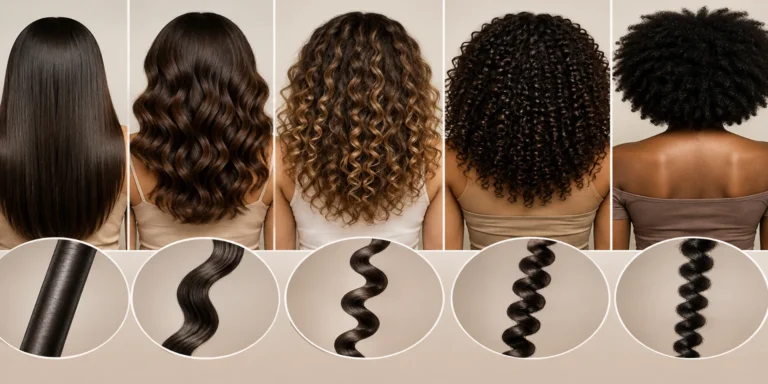
The classification system most stylists use splits hair into four numbered categories, each with three sub-levels labelled A, B, and C. The letter tells you how tight the pattern is within that category.
- Type 1 (Straight): No natural curl pattern. Reflects light easily and shows oil quickly.
- Type 2 (Wavy): A loose S-shape. Sits between straight and curly and often goes frizzy in humidity.
- Type 3 (Curly): Defined loops and spirals. Springy, with more volume and more dryness.
- Type 4 (Coily): Tight zig-zags or very small coils. The most fragile pattern and the thirstiest for moisture.
Knowing how to know your hair type matters because it changes what your hair needs. Straight hair needs volume and gentle cleansing. Coily hair needs moisture and protection. Buying products designed for the wrong category is why so many bathroom cabinets are full of half-used bottles.
Hair Type Chart
Find yourself in the chart below. Most people sit between two sub-types, which is completely normal.
| Hair Type | Appearance | Common Characteristics | Styling Difficulty |
| 1A | Completely straight, very fine | Soft, limp, holds no curl | Easy but hard to add volume |
| 1B | Straight with slight body | Medium thickness, more movement | Easy |
| 1C | Straight with a slight bend at the ends | Coarse strands, prone to frizz | Easy to moderate |
| 2A | Very loose, barely-there waves | Fine, easily weighed down | Easy |
| 2B | Defined S-waves from mid-length | Medium, frizzes in humidity | Moderate |
| 2C | Strong waves starting near the root | Coarse, thick, some loose curls | Moderate |
| 3A | Large loose curls, chalk-sized loops | Shiny, defined, prone to dryness | Moderate |
| 3B | Springy ringlets, marker-sized | Voluminous, dense, drier | Moderate to high |
| 3C | Tight corkscrew curls, pencil-sized | Very dense, shrinks noticeably | High |
| 4A | Small, defined coils | Soft, springy, retains some definition | High |
| 4B | Sharp Z-shaped bends | Less defined, significant shrinkage | High |
| 4C | Very tight coils, little visible pattern | Most fragile, up to 75% shrinkage | High |
Found your row? Good. That is only half the picture, because two people with identical 3B curls can still need completely different products.
What Are Hair Textures?
Many people are surprised to learn that hair textures have nothing to do with curl. Texture describes the width of a single strand, measured against a piece of sewing thread.
Fine hair is thinner than the thread. It feels almost invisible between your fingers, gets weighed down by heavy products, and struggles to hold a curl.
Medium hair feels roughly the same width as the thread. It is the most cooperative texture, holding styles well and tolerating most products.
Coarse hair is thicker than the thread, and you can clearly feel it. It is strong, holds styles for days, and needs more heat and more moisture to behave.
There is one more thing worth separating. Density is how many strands you have on your head, not how thick each one is. You can have fine strands packed densely together, which looks like thick hair but behaves like fine hair. This single confusion causes more product mistakes than anything else.
The other factor to check is porosity, which is how easily your hair absorbs and holds moisture. Drop a clean strand in a glass of water. If it sinks fast, porosity is high, and your hair loses moisture quickly. If it floats, porosity is low, and products tend to sit on the surface.
Hair Texture Chart
| Texture | Strand Thickness | Best Styling Methods | Extension Compatibility |
| Fine | Thinner than sewing thread | Lightweight mousses, volumising sprays, low heat | Lighter weight sets, fewer wefts, flat attachment methods |
| Medium | Similar to sewing thread | Most products work, holds curls and blowouts well | Widest range of options, blends easily with standard sets |
| Coarse | Thicker than sewing thread | Rich creams and oils, higher heat tolerance | Fuller, thicker sets needed for a natural match |
So you have a number, a letter, and a texture. Here is how the two systems actually relate to each other.
Hair Type vs Hair Texture: What’s the Difference?
| Factor | Hair Type | Hair Texture |
| Definition | The curl pattern your hair grows in | The width of each strand |
| Appearance | Straight, wavy, curly, or coily shape | Fine, medium, or coarse feel |
| Determined by | Follicle shape, genetic | Strand diameter, genetic |
| Styling needs | Dictates technique and tools | Dictates product weight and heat level |
| Product choice | Curl creams versus smoothing serums | Lightweight versus rich formulas |
| Extension impact | Determines the pattern you need to match | Determines the weight and volume you can carry |
This is exactly why matching extensions by photo alone fails so often. A set can have the right curl pattern and still look wrong because the strands are far coarser than yours. You need both to match.
How to Know Your Hair Type at Home
Here is a simple way to find out, and it takes about two minutes of actual effort spread across one wash.
- Wash with a clarifying shampoo – Product buildup hides your real pattern.
- Skip all styling products – No cream, no mousse, nothing.
- Air dry completely – No towel scrunching, no diffuser, no touching. Handling changes the result.
- Look at your dry hair in a mirror – Whatever shape it formed on its own is your true type.
- Compare against the chart above – Note that many people have two patterns, often looser at the crown and tighter underneath.
- Test one strand against sewing thread – Thinner is fine, similar is medium, thicker is coarse.
- Run the water glass test for porosity – Sinks fast means high, floats means low.
Find Your Hair Type in 2 Minutes: Quick Checklist
- Does your air-dried hair form no visible bend? Type 1.
- Does it form soft S-shapes without ringlets? Type 2.
- Does it form defined spirals you could wrap around a pen? Type 3.
- Does it form tight coils or sharp zig-zags? Type 4.
- Can you barely feel a single strand between your fingers? Fine.
- Can you feel it clearly and firmly? Coarse.
- Does a strand sink in water within thirty seconds? High porosity.
Pro Tip: Check your hair pattern at the nape of your neck, not the crown. The crown is exposed to the most sun, heat, and brushing, so it is often looser and more damaged than your true pattern. The hair underneath at the back is the honest sample.
How Hair Type Affects Hair Extensions
Straight hair – The easiest to match, but also the least forgiving. Straight hair shows attachment points clearly, so placement matters more than with any other type. Choose sets that are silky rather than heavily textured.
Wavy hair – Natural movement hides wefts beautifully. The challenge is consistency, because your waves change with the weather while extensions do not. Many wavy-haired people style both together with a curling iron to keep everything uniform.
Curly hair – Match the curl pattern as closely as you can, and account for shrinkage. Curly extensions often look longer in the packet than they will on your head. Temporary methods usually suit curls better, since you can remove them for wash day.
Coily hair – Protective methods like sew-ins are the traditional choice for good reason, since they shield your natural hair while adding length. Look for extensions specifically labelled for 4A to 4C patterns rather than generic curly sets.
Which Hair Extensions Match Your Hair Texture?
Texture decides weight, and weight decides comfort.
Fine hair – Go lighter than you think you need. Too many grams causes tension, and too much volume looks obviously added. Flat-attaching methods spread weight best.
Medium hair – You have the widest choice available. Almost any method and weight will blend, so choose based on lifestyle rather than limitation.
Thick or coarse hair – You need more hair than average for a natural result, and finer extension hair will look wispy against your own. Match coarseness, not just colour.
Curly textures – Buy from vendors who show unstyled photos of the actual curl pattern, not heat-straightened stock images.
Colour-treated hair – Processed hair is more porous and often weaker, so choose gentler, temporary methods while it recovers. For deciding between methods, our guide on how to choose high-quality hair extensions covers what to inspect before buying.
Common Mistakes When Identifying Hair Type
Common Mistake: Judging your hair while it is wet. Wet hair stretches, clumps, and looks far straighter or far curlier than it really is. Every reliable hair type assessment is made on completely air-dried, product-free hair. Assess it wet, and you will buy the wrong products for years.
The other traps to watch for:
- Confusing texture with density. Lots of fine hair is still fine hair.
- Ignoring porosity entirely, which explains most “nothing works on my hair” frustration.
- Using heat-damaged hair as your reference sample.
- Assuming every curl is a 3B because that is what the internet shows most.
- Buying extensions on colour alone without checking pattern and coarseness.
If you would rather not eyeball it, the find your perfect match tool filters by type, length, colour, and texture so the shortlist arrives already narrowed.
Hair Care Tips for Every Hair Type
Straight hair – Wash every one to two days as oil travels down the shaft quickly. Use lightweight conditioner on the ends only, and brush daily with a boar bristle brush.
Wavy hair – Wash two to three times a week. Skip heavy oils that flatten the pattern, and scrunch rather than comb when damp to encourage definition.
Curly hair – Wash once or twice a week, or co-wash between shampoos. Detangle only when wet and conditioned, always with fingers or a wide-tooth comb, working from the ends up.
Coily hair – Wash weekly or fortnightly, and prioritise moisture above everything. Deep condition regularly, seal with an oil or butter, and use protective styles to reduce daily manipulation. Braided styles are a proven option, and this complete guide to box braids covers the practical side.
Across every type, one rule holds: never sleep on cotton. A silk or satin pillowcase reduces friction, frizz, and breakage regardless of your pattern.
Why Choose The NiCa Collection?
Knowing your hair type solves half the problem. The other half is finding a seller who can actually tell you what their hair is.
The NiCa Collection is a curated marketplace connecting verified hair extension and wig vendors with stylists and customers in one place. Every vendor passes a multi-step quality and review process, so the listings you browse have already been filtered for authenticity rather than left for you to judge from a photo.
The smart matching system lets you filter by type, length, colour, and texture at once, which is exactly the combination that makes extensions disappear into natural hair. Stylists use the same platform their clients do, and buyer protection covers your purchase either way.
Browse the marketplace of premium hair extensions when you know your numbers, if you want the process explained first, or talk to our team if you would like a second opinion on your match.



Frequently Asked Questions
What are the four main hair types?
Type 1 straight, Type 2 wavy, Type 3 curly, and Type 4 coily, each divided into A, B, and C subcategories.
How do I know my hair type?
Wash without products, air-dry fully, then compare your natural pattern against a hair type chart in good light.
What is the difference between hair type and hair texture?
Hair type is your curl pattern. Hair texture is the thickness of each strand, from fine to coarse.
What is a hair type chart?
A reference chart classifying hair from 1A to 4C by curl pattern, helping you match products, styling, and extensions.
What are the different hair textures?
Fine, medium, and coarse, measured by comparing a single strand against a piece of standard sewing thread.
Which hair extensions work best for fine hair?
Lighter-weight sets with flat attachment methods, using fewer wefts to avoid tension and visible bulk at the roots.
Can I wear extensions with curly hair?
Yes. Match your curl pattern closely and allow for shrinkage, since curly extensions appear longer before they are worn.
Does hair texture affect extension choice?
Yes. Coarse hair needs thicker extension strands to blend, while fine hair needs lighter sets to stay comfortable.
How often does hair texture change?
Texture can shift with hormones, age, pregnancy, medication, or damage. Reassess every couple of years or after major changes.
Which extensions should I choose from The NiCa Collection?
Filter by your curl pattern, texture, colour, and length using the match tool, then compare verified vendors within budget.
Final Thoughts
Learning your hair types and hair textures is one of those small pieces of knowledge that quietly improves everything else. Products start working. Styling takes less time. And extensions stop looking like extensions.
There is no better or worse category here. Fine 1A hair and dense 4C coils are simply different, with different needs and different strengths. The goal is never to change your pattern, only to work with it.
Take two minutes tonight, wash without products, let your hair dry on its own, and see what it actually does. Then explore The NiCa Collection’s verified vendors and find hair that matches the pattern and texture you were born with.



Bangs Hair: Types, Hairstyles and Face Shape Guide
Bangs hair is a section of hair at the front of the head that is cut shorter than the rest, so it falls over the forehead. In the UK and
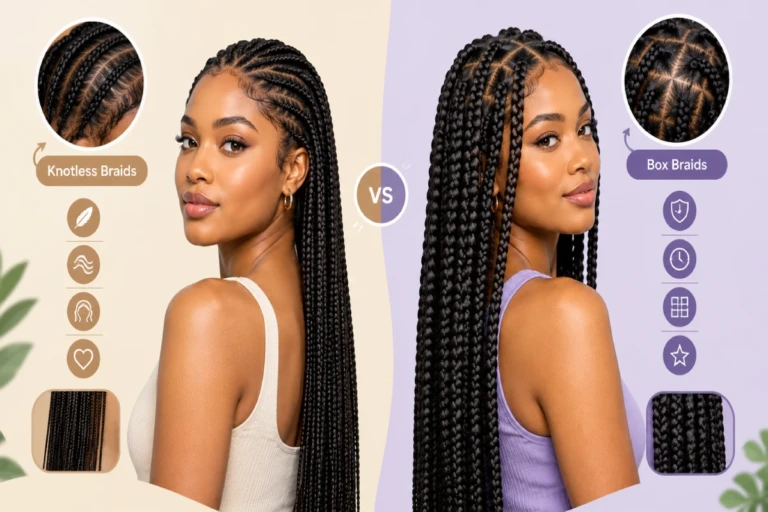
Knotless vs Box Braids: Difference, Lasting Time, Comfort and Style
The main difference between knotless vs box braids comes down to how each style starts at the root. Box braids start with a small knot that secures the extension hair

Difference Between 3C and 4A Hair: Types, Texture & Styles
If you’ve ever looked at a curl chart and felt like your hair belongs in two boxes at once, you’re in good company. 3C and 4A sit right next to