Why Some Hair Looks Amazing… Until Wash #3
By Genia Stewart, Founder & CEO, The NiCa Collection
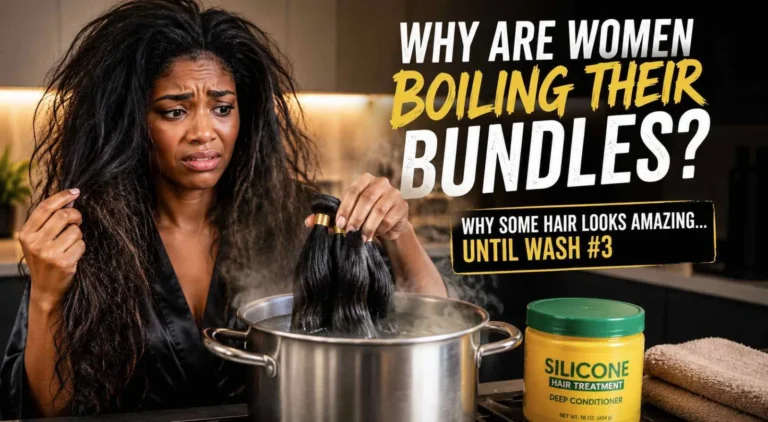
Spend a few minutes on TikTok and you’ll find it: women standing over pots of boiling water, dunking their hair extensions like they’re cooking pasta.
Some swear by deep conditioner mixed in. Others add Silicon Mix — that bright yellow tub you can grab at CVS or your nearest beauty supply for around $9. The before-and-after videos are genuinely impressive. Hair goes from stiff and dull to soft, shiny, and manageable in minutes.
But here’s the question nobody in those comment sections is asking:
Why are we paying $200, $300, even $500 for “luxury” hair — and then boiling it back to life three weeks later?
That’s not a care routine. That’s a red flag.
The Trend Didn’t Come Out of Nowhere
The bundle-boiling trend went viral because it gave a name to something millions of women were already experiencing. The frustration was real before the videos arrived.
The hair that felt silky and flawless during the first install started tangling by week two. The movement was gone. The softness disappeared. Washing it made things worse. Shedding increased. What started as a luxury purchase started feeling like a maintenance nightmare.
Social media didn’t create the problem. It just turned the frustration into content — and the “fix” into a trend.
The Silicon Mix phenomenon is part of the same story. That yellow tub with the green lid has been a staple in Black households for decades, originally used on natural hair. Today it’s showing up in extension restoration tutorials because women are desperate to recover the feel of hair that aged too fast. And for a short window, it works — it softens, adds shine, and improves slip.
But here’s what those tutorials won’t tell you:
Silicon Mix and boiling water can improve the feel of the hair temporarily — but they cannot permanently restore quality that was compromised long before the hair reached you.
What’s Actually Happening to Your Hair
Before hair reaches the shelf — or your doorstep — it often goes through a significant refinement process. Depending on the manufacturer, this can include silicone coating, cuticle stripping, texture enhancement, and chemical processing. All of it is designed to make the hair look and feel incredible at the point of sale.
And it works.
Silicone-coated hair is genuinely beautiful on first touch. It’s smooth, glossy, and moves like a dream. There’s a reason it photographs well and sells fast.
The problem is that silicone coating is temporary. Every wash cycle, every round of heat styling, every day of normal wear — it strips away.
And what’s left underneath is the actual hair: often over-processed, with compromised or misaligned cuticles that were never able to perform naturally to begin with.
That’s when the tangling starts. That’s when the dryness sets in. That’s when you find yourself standing over a pot of boiling water at 11pm, hoping to get one more install out of a $300 purchase.
Let’s Talk About Cuticles — Because This Is Where It Gets Real
The cuticle is the outermost layer of each strand of hair. Think of it like roof shingles: when they all lay flat in the same direction, root to tip, water runs off cleanly, the surface stays smooth, and everything holds together.
High-quality, minimally processed hair — what the industry calls raw or virgin hair — has intact, aligned cuticles. This is what allows the hair to:
- absorb moisture naturally
- resist tangling
- respond well to heat
- maintain its texture wash after wash
Much of the commercially processed hair marketed under labels like “Brazilian,” “Peruvian,” and “Malaysian” may undergo aggressive refinement methods designed to create a smoother, more uniform appearance. In some manufacturing environments, this can include processes that impact cuticle integrity over time while silicone coatings are used to temporarily recreate the look and feel of healthier hair.
This is why premium hair should behave beautifully through months of wear — and why hair with compromised cuticles starts breaking down far too soon.
Conditioning treatments like Silicon Mix can improve the surface feel temporarily. They cannot rebuild cuticle structure. They are not meant to.
When you’re boiling your bundles to get the softness back, you’re not restoring the hair.
You’re buying back a few more weeks from hair that was already behind on its promises.
The Grade Labels Are Not Helping You
If you’ve shopped for extensions in the last decade, you’ve seen the grading systems:
They’re printed on every package like a quality guarantee.
They aren’t.
There is no governing body, industry certification, or regulatory standard that controls what “12A” means. A vendor can print any number on any package without meeting a single objective benchmark.
Two vendors can sell completely different quality products under the same grade label.
The system exists to signal quality — not verify it.
This is one of the most important things a hair buyer can know going into a purchase:
The label is marketing. The hair has to prove itself.
What Long-Term Quality Actually Looks Like
Instead of chasing grade labels or trusting a beautiful first install, these are the performance questions worth asking before committing to a vendor:
- How does this hair behave after five washes — not one?
- Does the density stay consistent from root to tip, or does it thin out quickly?
- How does it respond to moisture? Does it absorb it, or bead up and repel it?
- Is the vendor transparent about where the hair is sourced and how it’s processed?
- What happens if the hair underperforms? Is there a real return policy behind it?
The best extensions don’t require constant revival.
They maintain softness, movement, and texture over time — with normal care, not heroic intervention.
Why We Built NiCa Around Testing, Not Trust
At The NiCa Collection, we were built for exactly this moment in the industry.
Every vendor on our marketplace goes through our proprietary 6-Test Quality Protocol before a single product is listed.
Static Test
Heavily silicone-coated hair generates excessive static. We test for it.
Water Test
Quality hair absorbs water naturally. Processed hair repels it. We check.
Burn Test
Human hair and synthetic fibers burn differently. We verify what you’re actually buying.
Cuticle Direction Test
We inspect whether cuticles are intact and properly aligned — not stripped and sealed with coating.
Bleach Test
We evaluate how the hair responds to chemical processing.
Wash Test
We assess behavior and texture after multiple wash cycles — because that’s when the truth comes out.
We don’t accept grade labels. We don’t take a vendor’s word for it.
We test.
Then we tier vendors based on our 13-point scoring framework covering:
- quality
- sourcing transparency
- service standards
- and long-term product performance
Because women in this industry have spent long enough paying premium prices for hair that requires a boiling pot and a YouTube tutorial to survive month two.
We inspected every vendor so you don’t have to.
The Boiling Water Trend Is Telling Us Something
The bundle-boiling videos aren’t just content.
They’re a signal.
Millions of women are actively working to restore hair that deteriorated faster than it should have.
That’s not a coincidence.
And it’s not a product care failure.
It’s a quality gap — and it’s been normalized for so long that people have started treating a breakdown as a beauty routine.
Silicon Mix is a great product. Boiling water is a real technique.
But neither of them should be necessary three weeks after a $300 install.
You deserve hair that keeps its promise past wash #3.
That’s the standard NiCa was built to hold.
Shop verified vendors at www.thenicacollection.com
Every vendor. Every product. Tested before it’s listed.
Be Bold. Be Beautiful. Be NiCa.