
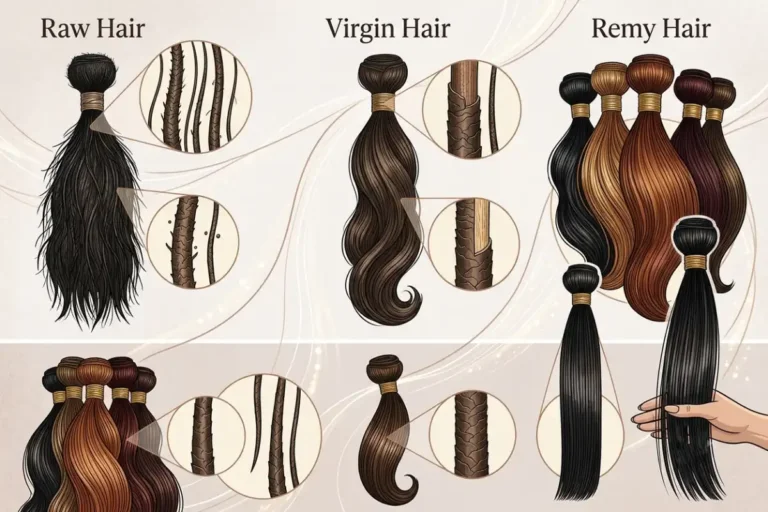
The hair extension industry is filled with terms like raw hair, virgin hair, Remy hair, and non-Remy hair. While these labels are commonly used by brands and suppliers, many shoppers don’t fully understand what they actually mean. In many cases, the terms are used interchangeably, creating confusion and making it difficult to determine the true quality of the hair being purchased.
The reality is that these terms describe different aspects of the hair. Some refer to how the hair has been processed, while others refer to the condition and alignment of the cuticles. Understanding the difference is essential if you want to invest in high-quality hair extensions, wigs, or bundles.
In this first installment of The Truth About Hair Origins series, we’ll break down the differences between raw hair, virgin hair, Remy hair, and non-Remy hair so you can make informed purchasing decisions.
Understanding the Key Difference
The easiest way to understand these hair classifications is to separate them into two categories:
Processing Level
This describes what has been done to the hair after it was collected.
- Raw Hair
- Virgin Hair
- Processed Hair
Cuticle Alignment Quality
This describes how the hair cuticles are arranged.
- Remy Hair
- Non-Remy Hair
This distinction is important because a hair bundle can belong to both categories at the same time.
For example:
- Raw Remy Hair
- Virgin Remy Hair
- Processed Remy Hair
- Non-Remy Hair
Many brands focus on one label while ignoring the other, which often leaves customers with an incomplete picture of what they’re actually buying.
What is Raw Hair?
Raw hair is considered the most natural form of human hair available. It is collected directly from donors and undergoes minimal processing before being sold.
Because the hair remains in its natural state, it retains its original texture, strength, and cuticle integrity.
Characteristics of Raw Hair
- Collected from a single donor whenever possible
- No chemical processing
- No permanent color treatments
- No texture alterations
- Natural cuticles remain intact
- Available in naturally occurring textures
Raw hair often exhibits slight variations in texture, color, and wave patterns because it has not been chemically manipulated. These natural inconsistencies are often a sign of authenticity rather than a defect.
Pros of Raw Hair
- Long lifespan with proper care
- Natural appearance and movement
- Excellent durability
- Can be colored and styled professionally
- Minimal tangling when cuticles remain aligned
Cons of Raw Hair
- Higher price point
- Limited availability
- Texture consistency may vary between bundles
- Requires proper maintenance
What is Virgin Hair?
Virgin hair is human hair that has never undergone chemical processing before collection from the donor. However, unlike raw hair, virgin hair may undergo certain manufacturing processes after collection to create more uniform textures and appearances.
This is where many consumers become confused.
While all raw hair is technically virgin hair, not all virgin hair qualifies as raw hair.
Characteristics of Virgin Hair
- No chemical processing before donation
- Cuticles may remain intact
- Often steamed to create texture patterns
- More uniform appearance
- Available in consistent curl and wave patterns
Virgin hair may be offered in textures such as:
- Body wave
- Deep wave
- Loose wave
- Straight
- Curly
These patterns are often created through steam processing rather than harsh chemical treatments.
Pros of Virgin Hair
- More affordable than raw hair
- Consistent texture across bundles
- Natural look and feel
- Wide variety of styles available
Cons of Virgin Hair
- May not be completely unprocessed
- Quality can vary between suppliers
- Not always sourced from a single donor
Raw Hair vs Virgin Hair
Many consumers assume these terms mean the same thing, but there are important differences.
Raw Hair
- Completely unprocessed
- Natural texture remains untouched
- Usually sourced from single donors
- Less uniform appearance
- Premium pricing
Virgin Hair
- Hair is unprocessed before collection
- May undergo steam texturing afterward
- More consistent appearance
- More widely available
- Generally more affordable
The main distinction lies in the level of post-collection processing.
Raw hair remains as close as possible to its natural state, while virgin hair may be modified to achieve specific textures and consistency.
What is Remy Hair?
One of the biggest misconceptions in the hair industry is that Remy hair is a type of hair origin. It is not.
Remy refers specifically to the alignment of the hair cuticles.
For hair to qualify as Remy, all strands must be collected and arranged so the cuticles face the same direction from root to tip.
This alignment helps reduce friction between strands and contributes to smoother, healthier-looking hair.
Characteristics of Remy Hair
- Cuticles aligned in one direction
- Reduced tangling
- Reduced matting
- Natural shine
- Longer lifespan
Because the cuticles remain aligned, Remy hair tends to behave more like natural growing hair.
Why Remy Does Not Mean Raw or Virgin
This is one of the most misunderstood concepts in the industry.
Remy describes cuticle alignment, not processing level.
As a result, several combinations are possible.
Raw Remy Hair
- Unprocessed hair
- Natural texture
- Cuticles aligned
This is often considered the highest-quality hair available.
Virgin Remy Hair
- Virgin hair source
- Possible steam processing
- Cuticles aligned
This is one of the most common premium extension categories.
Processed Remy Hair
- Hair has been colored or treated
- Cuticles remain aligned
Even though the hair has been processed, it can still qualify as Remy.
This is proof that Remy and virgin are not interchangeable terms.
What is Non-Remy Hair?
Non-Remy hair refers to hair where the cuticles are not aligned in the same direction.
This typically occurs when hair is collected from multiple sources such as salon floors, brushes, or mixed donations.
Because strands face different directions, the cuticles rub against one another.
The result can be increased friction, tangling, and matting.
Characteristics of Non-Remy Hair
- Mixed cuticle directions
- Greater tangling potential
- Lower durability
- Often chemically processed
- Typically less expensive
To improve appearance, manufacturers frequently remove or strip the cuticle layer entirely and apply silicone coatings to create temporary smoothness.
Initially, the hair may appear shiny and soft.
However, after several washes, the coating often wears away, revealing dryness, tangling, and reduced quality.
How to Identify Quality Hair
When evaluating hair extensions or wigs, don’t rely on a single label.
Instead, ask suppliers specific questions.
Questions to Ask
- Is the hair raw, virgin, or processed?
- Are the cuticles intact?
- Is the hair Remy or non-Remy?
- Has the hair been chemically treated?
- Is the texture natural or steam-processed?
- Is the hair sourced from single donors or multiple donors?
The answers will provide a much clearer picture of quality than marketing terminology alone.
Which Hair Type Is Best?
The best choice depends on your goals, budget, and styling preferences.
Choose Raw Remy Hair If:
- You want the highest quality available
- You plan to use the hair for years
- You prefer natural textures
- You don’t mind paying a premium
Choose Virgin Remy Hair If:
- You want excellent quality at a lower cost
- You prefer consistent textures
- You want a balance between performance and affordability
Choose Processed Remy Hair If:
- You want pre-colored options
- You prefer specific styles or shades
- You understand the lifespan may be shorter
Choose Non-Remy Hair If:
- Budget is your primary concern
- The hair is intended for short-term use
- You don’t require maximum longevity



Final Thoughts
The biggest takeaway is that raw, virgin, Remy, and non-Remy are not competing terms. They describe different characteristics of the hair.
Remember:
- Raw and virgin describe the processing level.
- Remy and non-Remy describe cuticle alignment quality.
Because of this, a bundle can be raw Remy, virgin Remy, processed Remy, or non-Remy.
Understanding these distinctions helps cut through marketing claims and allows you to evaluate hair based on actual quality rather than labels alone.
As we continue The Truth About Hair Origins series, we’ll explore sourcing practices, donor origins, processing methods, and how these factors influence the performance, longevity, and value of human hair products.





Bangs Hair: Types, Hairstyles and Face Shape Guide
Bangs hair is a section of hair at the front of the head that is cut shorter than the rest, so it falls over the forehead. In the UK and
Knotless vs Box Braids: Difference, Lasting Time, Comfort and Style
The main difference between knotless vs box braids comes down to how each style starts at the root. Box braids start with a small knot that secures the extension hair

Difference Between 3C and 4A Hair: Types, Texture & Styles
If you’ve ever looked at a curl chart and felt like your hair belongs in two boxes at once, you’re in good company. 3C and 4A sit right next to