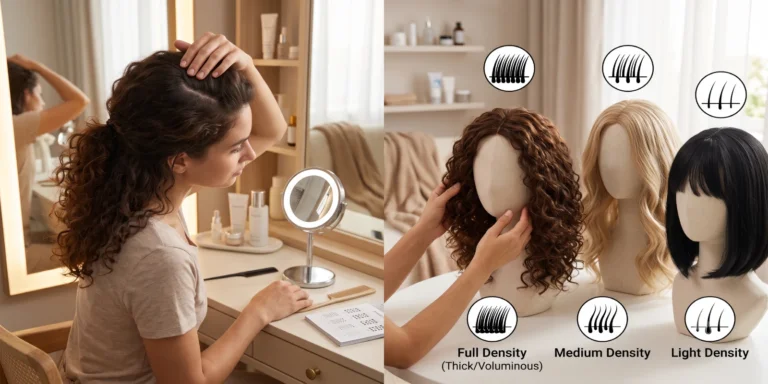
Buying a wig sounds straightforward until you’re staring at a product page trying to figure out what “150% density” actually means and whether it’s right for you.
Density is one of those terms that gets thrown around a lot in the wig world, but rarely gets a clear explanation. And if you get it wrong, the wig either looks too flat, too puffy, or just… off.
This guide breaks it all down in simple terms. You’ll learn what hair density means, how to check your own natural hair density, how to read a wig density chart, and how to pick the best density for the look you’re going for.
What Does Hair Density Mean?
Hair density refers to how much hair is on a given area of the scalp or, in the case of a wig, how many hair strands are sewn into the cap.
It’s different from hair thickness (also called hair texture). Thickness is about how wide each strand is. Density is about how many strands there are altogether.
Think of it this way:
- Thickness = the size of each tree in a forest
- Density = how many trees are packed into that forest
When someone talks about wig density, they’re describing how full or voluminous the wig looks overall. A higher density means more hair, more fullness, more volume. A lower density means lighter, more natural-looking coverage.
How to Check Hair Density at Home
Before you buy a wig, it helps to understand your own natural hair density. This gives you a baseline and helps you pick a wig that blends well or matches your natural look.
Here’s how to check hair density without any special tools:
The Ponytail Test
Pull all your hair into a low ponytail and measure the circumference at the base.
- Thin density: less than 2 inches around
- Medium density: 2-4 inches around
- Thick density: more than 4 inches around
The Scalp Visibility Test
Part your hair and look at your scalp without pulling or stretching.
- If your scalp is clearly visible through the part, you likely have low or thin density.
- If you can barely see your scalp, your density is medium to high.
- If your scalp is completely hidden even with a clean center part, your hair is high-density.
The Mirror Method
Stand in natural lighting (not a bathroom mirror with harsh overhead light). Look at the overall volume of your hair when it’s down.
- Does it lie flat and close to your head? – Low density
- Does it have some body but not excessive volume? – Medium density
- Does it feel heavy, full, and thick all the way through? – High density
These simple methods are surprisingly accurate for day-to-day decisions like choosing wigs, extensions, or styling products.
Understanding the Wig Density Chart
A wig density chart shows how different density percentages translate to real-world fullness. Most wigs are measured in percentages, starting from around 60% and going up to 250% or more.
Here’s what the main density levels actually look like:
60%-80% Density Very Light
This is the thinnest option available. It mimics the look of natural hair loss or very fine hair. Mostly used in medical wigs or to replicate a thinning hairline. Not common for everyday use.
100%-110% Density Natural Light
This is what most people’s natural hair looks like. It’s light, lies flat, and doesn’t feel heavy on the head. If you want something that looks like real, everyday hair, not overdone, this is a solid starting point.
120%-130% Density Natural to Medium
One of the most popular ranges. It has a little more body than 100% but still looks believable. Great for women with medium-density natural hair who want a seamless match.
150% Density Medium Full
This is the sweet spot for most wig buyers. It looks full and healthy without appearing exaggerated. It photographs well, styles easily, and works for most occasions, casual, work, or a night out.
180% Density Full and Voluminous
Noticeably thick and luxurious. Great for achieving big, bouncy styles like blowouts or body waves. It takes a little more product and effort to style, but it delivers dramatic results.
200%-250% Density Extra Full
Very thick, very voluminous. Common in theatrical styling or high-fashion looks. For everyday wear, this can feel heavy and look unnatural unless it’s intentional; think a big, bold, glamorous style.
What Is the Best Density for a Wig?
The honest answer: it depends on what you want the wig to do.
Here’s a quick guide based on common goals:
If you want the most natural-looking result: Go with 100%-130% density. It mimics real hair closely and blends well with your hairline.
If you want full, camera-ready hair: 150% is the go-to for a reason. It looks polished and intentional without looking overdone.
If you’re styling big curls, waves, or a blowout: 180% gives you the volume needed for those styles to pop.
If you have fine or thin natural hair: Start with 130%-150%. A lower density might look too sparse, but too high can look mismatched against your natural edges.
If you’re wearing a wig daily for long hours: Consider 130%-150%. High-density wigs (180%+) can feel heavy over extended wear.



How Hair Density Affects Different Wig Types
Not all wigs respond to density the same way. Wig construction plays a big role in how density looks when worn.
Lace Front Wigs
The lace panel at the front creates a natural-looking hairline. For lace front wigs, 130%-150% tends to work best, as it gives fullness to the mid-lengths and ends while keeping the hairline believable.
Full Lace Wigs
Since full lace wigs can be parted anywhere, density distribution matters more. 150% is the most common and versatile choice here.
U-Part and V-Part Wigs
These blend with your natural hair at the top, so a slightly lower density (around 130%) often creates a more seamless blend.
Closure Wigs
The closure sits at the top, and the rest of the wig provides the body. 150%-180% works well here since the closure gives a natural-looking part regardless of fullness.
Hair Density and Hair Texture: How They Work Together
One thing a lot of buyers overlook is how hair texture affects the perception of density.
- Straight hair at 150% can look thinner than curly hair at 150% because curls take up more space visually.
- Kinky or coily textures tend to look fuller at lower density percentages.
- Wavy textures fall somewhere in the middle; they add visual volume without the density needing to be as high.
So if you’re buying a curly wig, you might actually get away with a slightly lower density than you’d assume and still get excellent fullness.
When you’re shopping for extensions or wigs and want to find options across textures and densities, a curated marketplace makes it easier to compare products from verified vendors side by side so you’re not bouncing between 10 different sites trying to figure out what’s actually quality.
Common Mistakes When Choosing Wig Density
Here are a few things that trip people up, especially first-time wig buyers:
- Buying the highest density, assuming it’s better – More isn’t always better. 250% density on someone with fine natural edges can look very unnatural.
- Ignoring their own natural hair density – If your real hair is low-density, a 200% wig creates a jarring mismatch at the edges and hairline.
- Not considering the hairstyle they want – Sleek, straight styles show density more clearly. Curly, voluminous styles hide it. Choose accordingly.
- Forgetting about the cap size – A wig cap that doesn’t fit correctly can affect how density appears on the head; too loose, and even 180% can look flat.
- Assuming all brands measure density the same way – Unfortunately, there’s no universal standard. A “150%” from one brand might feel like “130%” from another. Reading reviews and buying from trustworthy vendors matters more than you’d think.
FAQ: Hair Density and Wigs
Q: What does hair density mean in simple terms?
Hair density refers to how many hair strands are present on your scalp or in a wig, determining overall fullness.
Q: What is the most popular wig density for everyday wear?
150% density is the most popular choice; it looks full, natural, and works well for most styles and occasions.
Q: How do I check my natural hair density at home?
Use the ponytail test to measure the circumference at the base. Under 2 inches is thin; 2-4 inches is medium; above 4 is thick.
Q: What wig density looks the most natural?
100%-130% density closely mimics how natural hair looks on most people without appearing overdone.
Q: Is 180% density too much for daily use?
For some, yes, it can feel heavy over long hours. 150% is usually the better balance for daily comfort and style.
Q: Does hair texture affect how density looks?
Yes, curly and coily textures appear fuller at the same density percentage compared to straight hair.
Q: What density is best for a lace front wig?
130%-150% works well for lace fronts; it keeps the hairline looking natural while giving the rest of the wig good body.
Q: Can I add extensions to a low-density wig?
You can blend extensions with a wig for extra volume, though professional help is recommended for a seamless result.
Q: What is the best density for thick natural hair?
If your natural hair is high-density, a wig at 150%-180% typically blends better with your own edges and hairline.
Q: Does wig density affect how long the wig lasts?
Indirectly, yes, higher-density wigs have more hair, which means more wear and stress on the cap over time.
Your Next Step to Getting the Right Wig
Hair density isn’t a complicated concept once you see it laid out clearly. It’s simply about fullness and matching that fullness to your goals, your natural hair, and the style you want to achieve.
The short version: most people do well with 130%-150%. Go lower if you want something subtle and natural. Go higher if you want drama and volume.
When you’re ready to shop, the quality of the product matters just as much as the density number. The NiCa Collection connects you with verified hair vendors offering a range of wigs and extensions across densities, so you can browse with confidence and find what actually fits your needs.
Get your density right, and everything else falls into place.



Bangs Hair: Types, Hairstyles and Face Shape Guide
Bangs hair is a section of hair at the front of the head that is cut shorter than the rest, so it falls over the forehead. In the UK and
Knotless vs Box Braids: Difference, Lasting Time, Comfort and Style
The main difference between knotless vs box braids comes down to how each style starts at the root. Box braids start with a small knot that secures the extension hair

Difference Between 3C and 4A Hair: Types, Texture & Styles
If you’ve ever looked at a curl chart and felt like your hair belongs in two boxes at once, you’re in good company. 3C and 4A sit right next to